A Megawatt of Blackwell Earns 2.5x a Megawatt of H100, So the Industry Is Warehousing the Blackwell
On Ornn's Nov 25 settles, a B300 cluster grosses 2.54 times an H100 cluster on the same megawatt. Yet H100 spot rents rose 5.8% over the past week while B300 fell 7.1%, and the only documented dark racks on record are Blackwell GB300s waiting for power.
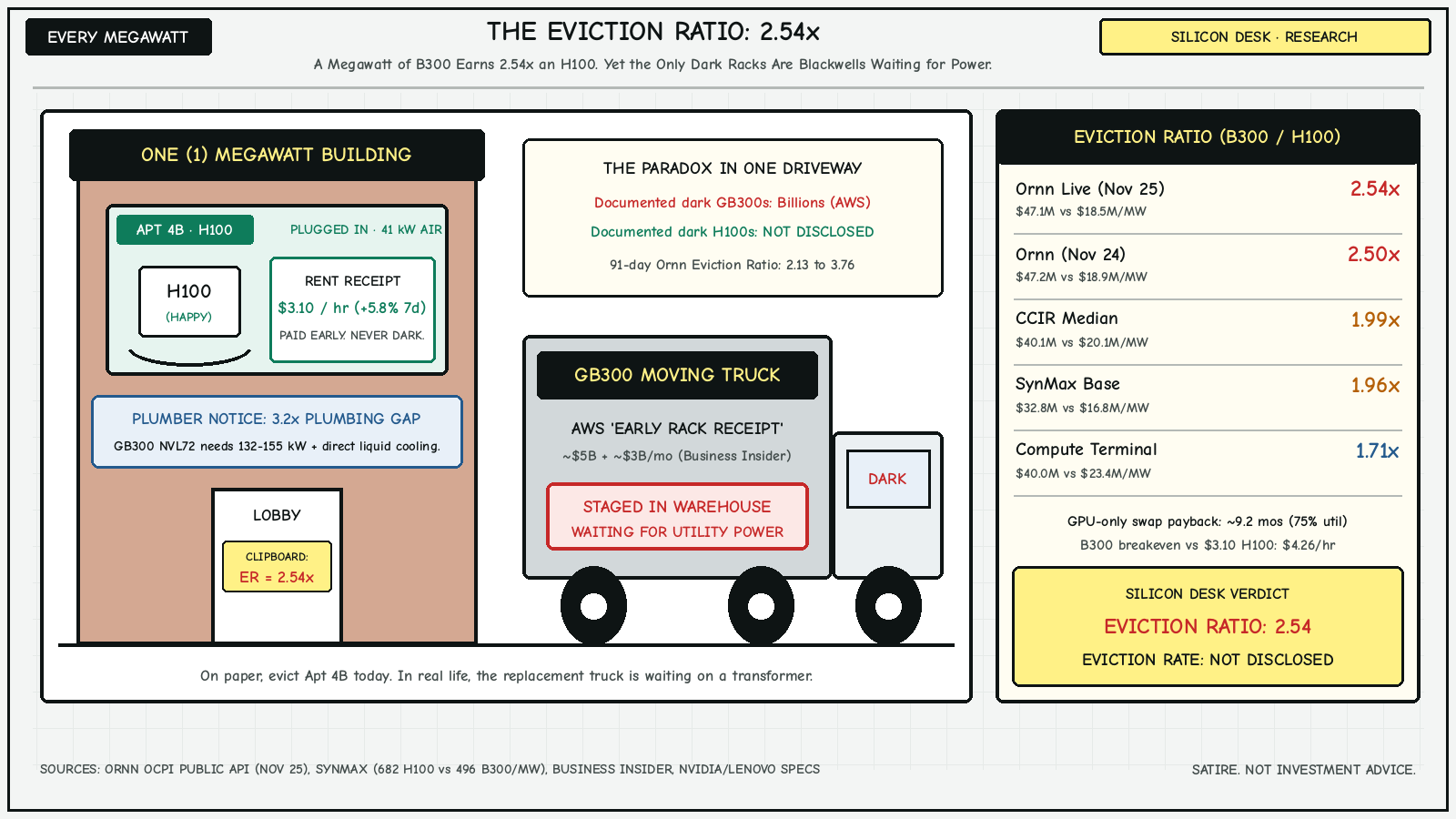
Every few weeks, AI infrastructure Twitter rediscovers the same scary thought: if electricity is the hard ceiling and Nvidia's (`NVDA`) Blackwell racks earn far more money per megawatt than older Hoppers, shouldn't every hyperscaler be ripping out its H100s and stacking them in a warehouse?
It is a clean landlord question. You own one megawatt of powered floor space. Tenant A (Hopper) pays decent rent and never calls maintenance. Tenant B (Blackwell) promises more than double the gross revenue on the exact same electric meter. On a spreadsheet, you print the eviction notice before lunch.
So the Silicon Desk ran the eviction math across five independent rental benchmarks, rebuilt a 91-day daily series from Ornn Data's public transaction API, checked vendor power and cooling sheets, and audited every public claim of "warehoused GPUs."
Here is the punchline. The landlord arithmetic is completely right: on Ornn's finalized November 25 settles, a megawatt of B300s grosses 2.54 times a megawatt of H100s. Yet the tenant everyone keeps threatening to evict is fully plugged in and getting a raise, while the only documented idle racks sitting in warehouses are the Blackwells themselves.
The Eviction Ratio: 2.54x on Ornn's Latest Tape
To test whether a chip swap makes sense where power is the binding constraint, we use SynMax's facility-meter density model (HGX-class servers at 1.15 PUE): 682 H100s per megawatt (1.466 kW all-in per GPU) versus 496 B300s per megawatt (2.012 kW all-in per GPU). You fit 27% fewer Blackwell chips into the same megawatt, so each B300 has to earn at least 1.375 times as much per hour just to tie an H100 at the meter.
We call the resulting gross revenue ratio The Eviction Ratio (ER): `(496 x B300 rate) / (682 x H100 rate)` at equal utilization. Above 1.0 favors evicting Hopper on top-line power economics. Below 1.0 means the old tenant wins the lease.
| Rate Source | H100 Rate | B300 Rate | H100 ($M/MW-yr, 100%) | B300 ($M/MW-yr, 100%) | Eviction Ratio |
|---|---|---|---|---|---|
| Ornn OCPI Settle (Nov 25, Live API) | $3.10 | $10.83 | $18.5M | $47.1M | 2.54 |
| Ornn OCPI Settle (Nov 24) | $3.16 | $10.87 | $18.9M | $47.2M | 2.50 |
| CCIR Neocloud Median (Nov 24) | $3.37 | $9.24 | $20.1M | $40.1M | 1.99 |
| SynMax Base Case (B200 Proxy) | $2.81 | $7.56 | $16.8M | $32.8M | 1.96 |
| Compute Terminal Neocloud (Nov 25) | $3.92 | $9.20 | $23.4M | $40.0M | 1.71 |
Every single board clears 1.0 by a mile. Across all five rate sources, the Eviction Ratio runs from 1.71 to 2.54, clustering right around 2x. At Ornn's November 25 H100 settle of $3.10 an hour, B300 rent would have to collapse all the way to $4.26 an hour (61% below its $10.83 print) before the two chips generated the same gross revenue on one megawatt.
The capex payback looks equally seductive on paper. Using SynMax's October hardware assumptions ($27.28 million for 496 new B300s at $55,000 each, minus $10.91 million from reselling 682 used H100s at $16,000 each, or $16.37 million net per megawatt), upgrading one megawatt at 75% utilization adds $21.4 million in annual gross revenue on Ornn's November 25 rates. That implies a 9.2-month simple payback on GPU cost alone (compared with SynMax's 16.3 months on its lower B200 proxy, and roughly 24 months to build a new $50 million greenfield megawatt). Notice what SynMax explicitly leaves out of that 9-to-16-month calculation: facility conversion, cooling retrofits, swap downtime, financing, and current secondary-market H100 liquidity.
Throughput benchmarks push the same direction. In SemiAnalysis InferenceMAX and InferenceX v2 testing, Blackwell racks generate roughly 3x to 8x (and up to triple-digit multiples at aggressive FP4 operating points) more tokens per provisioned megawatt than Hopper. SemiAnalysis's own caveat is worth reading twice: colocation rent and power account for less than 20% of total cost of ownership, so tokens-per-megawatt only dominates when power itself is the hard wall. Which is the exact wall the industry just hit.
91 Days of Ornn History: Never Below 2.13
To make sure this was not a one-day holiday quirk, we pulled the full 91-day finalized daily history (`Aug 27` through `Nov 25, 2026`) from Ornn's public index API for all four Nvidia generations.
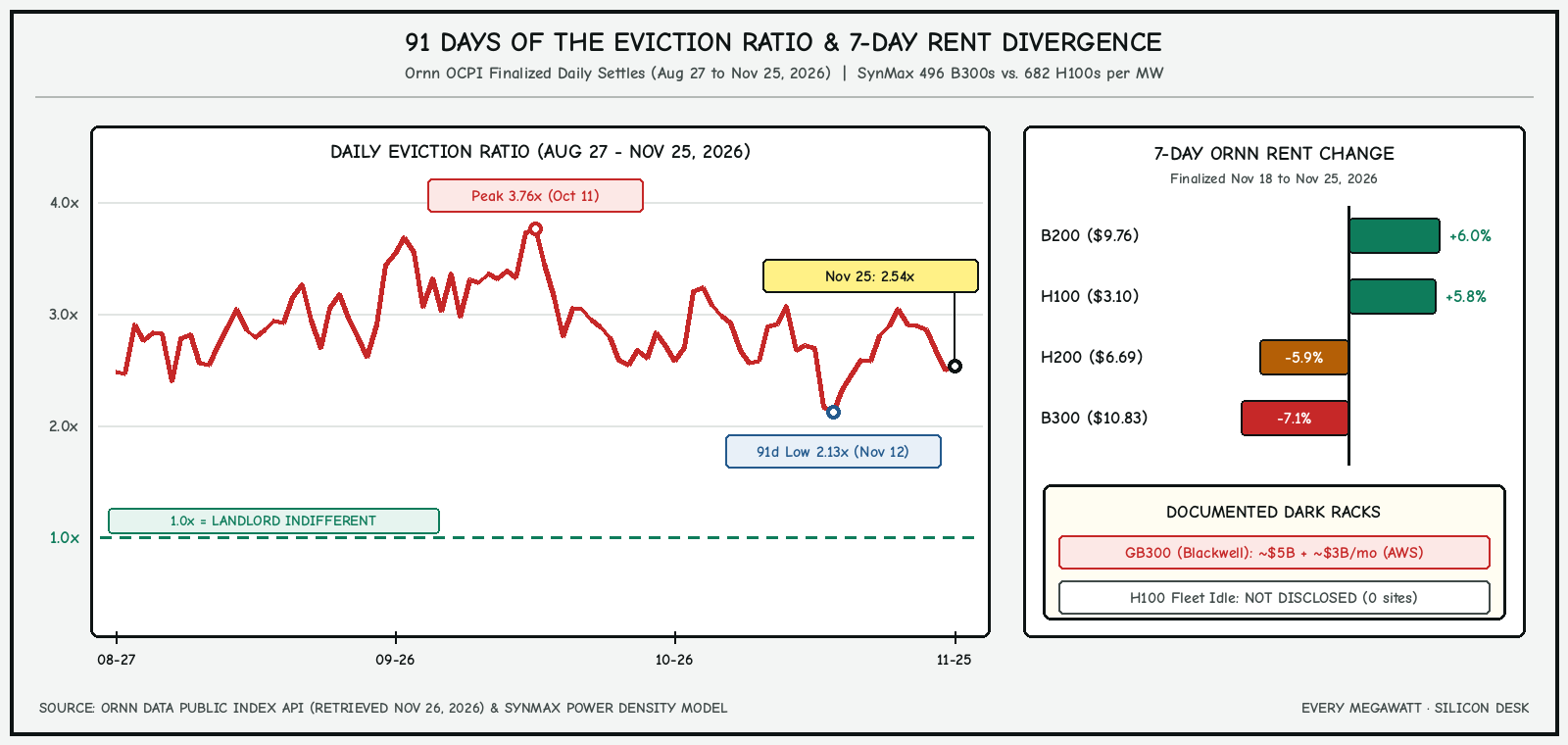
Across the entire 91-day tape, the Eviction Ratio never once dropped below 2.13 (set on November 12, when H100 spiked to $3.39 and B300 dipped to $9.93). It peaked at 3.76 on October 11 ($2.67 H100 vs. $13.81 B300) and closed November 25 at 2.54.
Yet look at the direction of travel over the last seven days (`Nov 18` to `Nov 25`): - H100 climbed +5.8% ($2.93 to $3.10), extending the rebound we tracked in Michael Dell's viral H100 post and our debut Jevons Card. - B200 rose +6.0% ($9.21 to $9.76), though still off its November 8 high. - H200 slipped -5.9% ($7.11 to $6.69). - B300 fell -7.1% ($11.66 to $10.83), down 24% from its mid-October peak of $14.23, right as secondhand recaps of a November 25 SemiAnalysis client note reported SpaceX cutting small-cluster Blackwell spot quotes to $10 to $12 an hour (building on the dynamic we covered in If You Can't Frontier Lab, You Neocloud Instead).
Meanwhile, on Polymarket's new compute yield curve, traders are pricing a 31.6% discount on H100 rents by December 2028, while secondary write-ups of recent calls report CoreWeave's Michael Intrator citing 30% to 50% quarter-over-quarter jumps in Ampere and Hopper renewals (Yahoo Finance) and Nvidia's Colette Kress noting Hoppers recontracting at up to twice original prices (TIKR). That is not how a market behaves when operators are dumping H100s into dark storage.
The Warehouse Audit: Which Chip Is Actually Dark?
If you search for who is actually warehousing GPUs, the narrative splits cleanly into two piles: unverified macro guesses and one documented operational bottleneck.
| Claim | Source | Generation | Audit Read |
|---|---|---|---|
| "At least $200B" of Nvidia chips sitting idle | Ed Zitron (Prof G Markets / X) | Unspecified | No inventory audit cited; HighVRAM & SemiFunctional note no independent reproduction |
| Microsoft "$50B to $100B" GPUs warehoused | Ed Zitron (Sept 22 newsletter) | Mostly Blackwell | Author's own estimate; explicitly notes Hopper fleet is mostly installed |
| ~$5B GB300 racks in Aug + ~$3B/mo staged in warehouses | Business Insider (Oct 20) | GB300 (Blackwell) | Internal AWS "Early Rack Receipt" emails; Amazon calls staging "best business practice" |
| Any named operator shelving or evicting an H100 fleet | Public filings & wires | H100 (Hopper) | NOT DISCLOSED (zero documented sites or counts) |
That is the entire irony of the "warehoused GPU" bear case. The one primary-reported warehouse stash on record belongs to Amazon Web Services (`AMZN`) under its "Early Rack Receipt" process, where Business Insider reported AWS took early ownership of roughly $5 billion in Nvidia GB300 racks (plus ~$3 billion a month projected) and staged them in intermediary warehouses because some U.S. sites had floor space without available utility power. Amazon called early staging "best business practice" to speed turn-up once power arrives.
Nobody in the public record has disclosed an idle H100 fleet, a count of evicted Hoppers, or a hyperscaler pulling running H100s off a powered busway to drop in Blackwell. As Silicon Data replied to Michael Dell on X, a powered, networked H100 "is not the same thing as a card sitting in a warehouse," estimating connected H100 residual value at roughly 68% of original sale price.
> Grid Desk Sidebar (Dale Ferranti): Same Hall, Wrong Plumbing. Why doesn't AWS simply unplug a row of H100s and wheel the dark GB300 racks into their place? Look at the vendor spec sheets. A standard air-cooled 4-node H100 rack draws roughly 41 kW (up to ~70 kW with rear-door heat exchangers). A liquid-cooled Nvidia GB300 NVL72 rack draws 132 to 142 kW nominal (Lenovo lists 135 kW TDP, peaking around 155 kW; HPE recommends 192 kW busway), weighs roughly 1,580 kg (3,480 lb), and rejects about 90% of its heat directly into liquid via coolant distribution units (Nvidia, Lenovo, LD Advisors). That is a 3.2x Plumbing Gap per rack. You can drop an air-cooled HGX B200 (~55 kW) into a legacy hall, but a rack-scale GB300 arrives with a plumber and a structural engineer. Meanwhile, SynMax's satellite data shows 15.0 GW of the 36.8 GW scheduled for 2027 slipping to 2028 or later, the exact shovel gap we flagged in our 52 GW grid check.
The Landlord's Verdict
Accounting teams still depreciate AI servers over five to six years at Alphabet, Amazon, Meta, and CoreWeave (two to six years at Microsoft), while bears argue economic life is closer to two or three years. Both sides are arguing over an eviction that has not been served.
The Eviction Ratio is 2.54. The eviction rate is not disclosed. Where a building already has liquid manifolds, heavy slabs, and 155 kW busways, Blackwell wins the megawatt handily. Where a hall was built for 41 kW air-cooled Hoppers, the old tenant keeps humming at $3.10 an hour while the shiny 2.5x replacement sits in a staging warehouse waiting for a transformer.
Every megawatt will be monetized, eventually. Right now, the ones actually plugged into the wall belong to Hopper, and the ones waiting on a utility interconnect are the chips supposed to replace them.
Satire. Not investment advice.
Sources
- Ornn Data H100 SXM Index
- Ornn Data B300 Index
- Ornn Data B200 Index
- Ornn Data H200 Index
- SynMax: The $25 Million Megawatt
- Business Insider: AWS Early Rack Receipt (Oct 20)
- Nvidia GB300 NVL72 Specs
- Lenovo GB300 NVL72 Product Guide
- LD Advisors GPU Rack Power & Cooling
- SemiAnalysis InferenceMAX
- SemiAnalysis InferenceX v2
- Compute Terminal GPU Prices
- CCIR Rates
- Gate News: SpaceX Blackwell Spot Cuts
- Yahoo Finance: Dell & CoreWeave Hopper Rents
- TIKR: Hopper Recontracting
- HighVRAM Hardware Watch
- SemiFunctional Tech
- Silicon Data on X
- The Jevons Card (Every Megawatt)
- Polymarket Compute Yield Curve (Every Megawatt)