U.S. Data Centers Could Add 52 Gigawatts in 2028, About Half of Them Still Theoretical
Data centers already drive more than a third of U.S. power demand growth, and a new Goldman Sachs note projects a 2028 wave where roughly 26 gigawatts have not yet met a shovel.
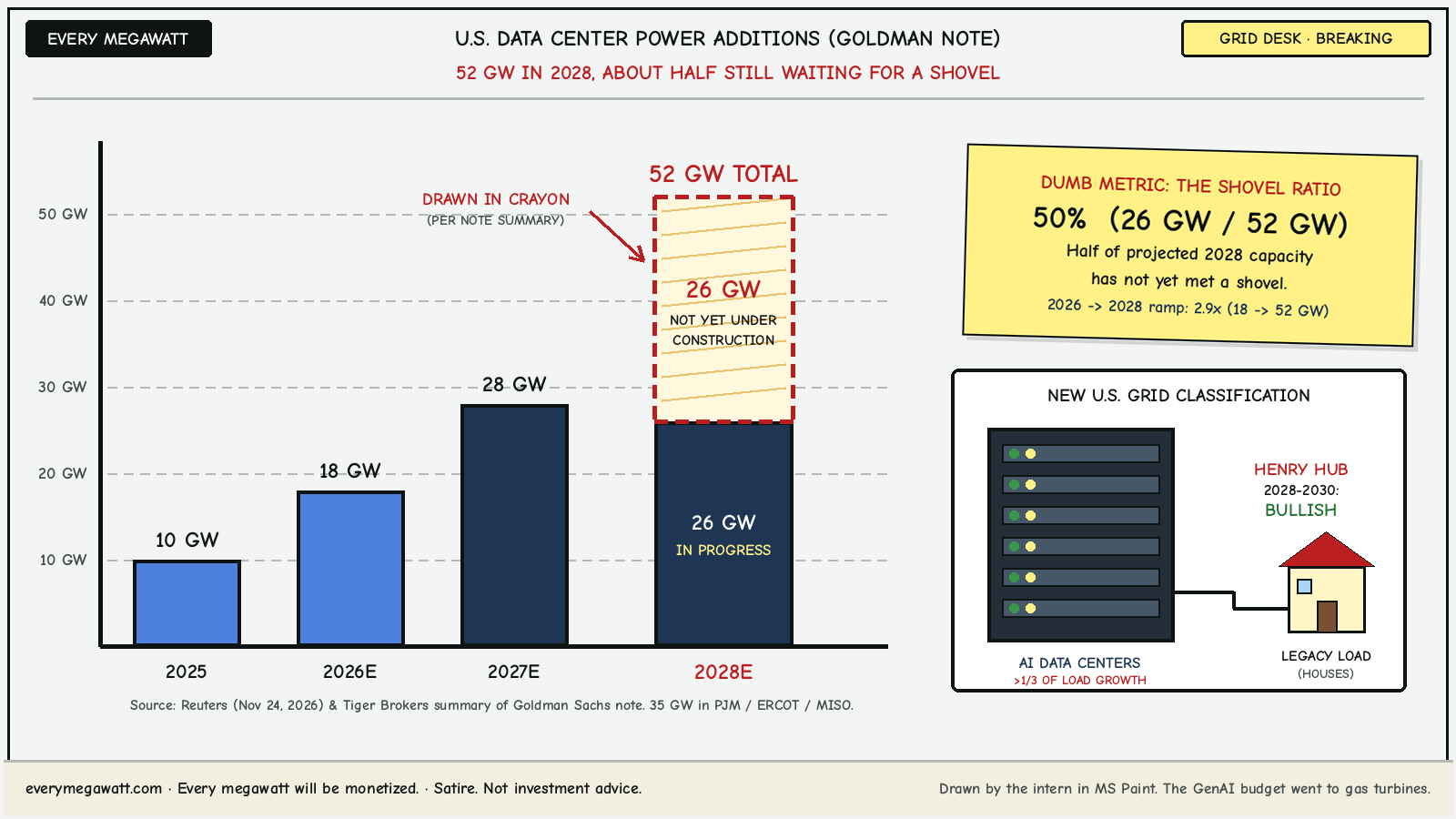
The U.S. electrical grid is now a data center network with a few million houses still attached to the side. In a client note dated Tuesday, November 24 and reported by Reuters via Yahoo Finance, Goldman Sachs (`GS`) said strong U.S. data-center power capacity growth is likely to continue through 2028, with an additional 52 gigawatts of data-center power capacity that could come online in 2028 alone.
This year is already doing plenty of lifting. As Reuters quoted the note: "Year-to-date, data-center power capacity and demand have increased by nearly 30% in the US, contributing to more than one third of US total power demand growth." Goldman added: "We expect growth acceleration in data centers to be driven not only by a higher volume of facilities, but by increasingly larger physical footprints and higher power density."
At that pace, residential customers are one interconnection study away from being reclassified as legacy load.
Half of 2028 Is Still a Spreadsheet
The fine print behind the 52 GW headline is where the hard hats meet the Excel tabs. According to a Tiger Brokers summary of the Goldman note, annual U.S. data-center additions climb from roughly 4 GW a year during 2021 to 2024 and 10 GW in 2025 to 18 GW in 2026, 28 GW in 2027, and 52 GW in 2028. That ramp already includes a haircut for historical delays and cancellations, though the staircase clearly declined to sit still for it.
The catch sits in the next sentence of the summary: roughly 26 GW of that 2028 wave had not yet started construction when the note published. Roughly 35 GW of the projected 2028 total is slated for PJM, ERCOT, and MISO, while U.S. maximum data-center power capacity was up 12 GW (+33%) year over year through the end of October.
In grid engineering, "not yet under construction" usually means a field, a land option, and a transformer quote dated sometime next decade. In AI infrastructure finance, it counts as an active construction phase scheduled for 2028 energization.
The Dumb Metric: The Shovel Ratio
Take the 2028 numbers from the summary of the note and run the division:
- Projected 2028 U.S. data-center additions: 52 GW
- 2028 capacity not yet under construction: ~26 GW
- The Shovel Ratio: 50% (`26 GW / 52 GW`) of next-next year's projected grid wave has never met a shovel.
- The Gigawatt Multiple: 2.9x (`52 GW in 2028 / 18 GW in 2026`), meaning the U.S. buildout is projected to nearly triple its annual energization pace in 24 months.
Henry Hub Gets the Tab
Goldman wrote in the note reported by Reuters that this expansion could tighten U.S. power markets and lift natural gas demand, reinforcing the bank's bullish Henry Hub outlook for 2028 to 2030. When racks get bigger and denser faster than transmission lines get built, marginal electrons tend to come out of a gas turbine.
Every megawatt will be monetized, eventually, even the 26,000 megawatts that are currently waiting on concrete, switchgear, and a backhoe. Meanwhile, overseas operators like GDS Holdings are already showing what happens when utility bills show up on the gross margin line before the megawatts even finish ramping.
Satire. Not investment advice.
Sources
- - Reuters via Yahoo Finance: Goldman says US data center boom through 2028 will lift power and gas demand (Nov 24, 2026, 10:24 PM ET)
- Investing.com (Reuters wire): Goldman says US data center boom through 2028 will lift power and gas demand (Nov 24, 2026)
- Tiger Brokers: Summary of Goldman Sachs US Data Center Power Note (Nov 2026)