If You Can't Frontier Lab, You Neocloud Instead
SpaceX's AI unit is renting roughly $3.1 billion a month of compute to Anthropic and $800 million to Google on 90-day leases, per The New York Times. The rental desk is now more than half of SpaceX revenue, leaving one question: is this a bridge, or is a rocket company now the biggest neocloud on Earth?
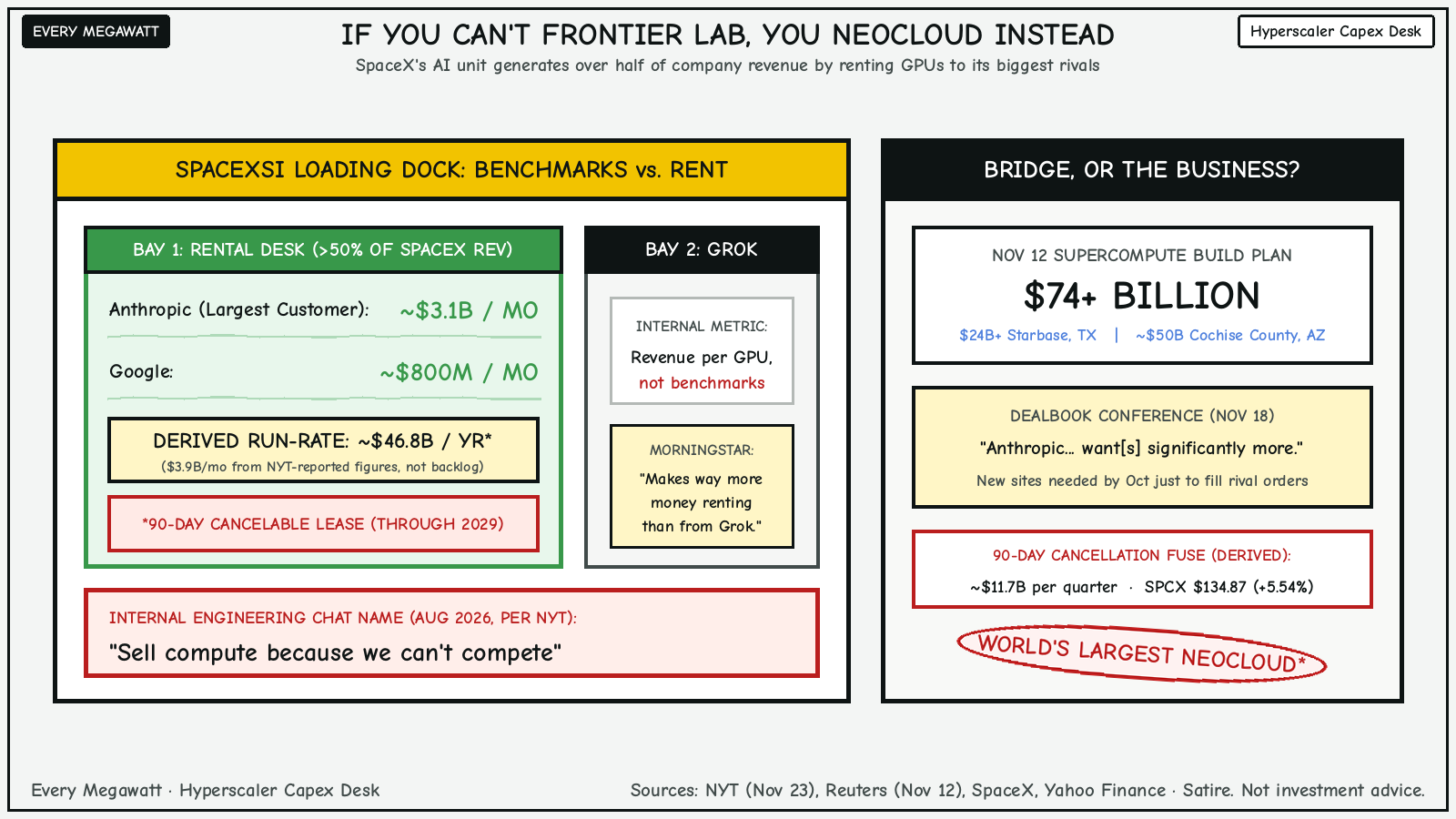
There is a new law in AI infrastructure: if you can't frontier lab, you neocloud instead.
According to The New York Times (summarized by Investing.com and Techmeme), SpaceX has been leasing computing power from its data centers to direct AI rivals Anthropic and Google since May while continuing to develop its own Grok chatbot. Three people familiar with the matter told the Times that employees were informed SpaceX was falling behind in AI development, making it more lucrative to rent its GPU clusters to competitors than to burn the chips on its own products.
The internal receipts viewed by the Times read like an economics textbook written in Slack. In August, an internal engineering group chat was temporarily renamed "Sell compute because we can't compete." One message inside the chat laid out the math with zero romance: "At the end of the day, the only thing that matters for competitiveness is revenue per GPU, not benchmarks. If you can't pay for your GPUs, then you either go bankrupt or you become a computer rental company. Move the needle on revenue."
It turns out the computer rental business pays remarkably well. Per the Times, Anthropic is now paying roughly $3.1 billion a month to rent SpaceX compute, making a direct rival the largest customer of SpaceX's AI unit, SpaceXSI. Google is paying roughly $800 million a month. Put those two NYT-reported monthly figures together and you get a derived $3.9 billion a month, or $46.8 billion annualized if that run-rate held for a full year.
That rental desk is no longer a side hustle. As Reuters reported on November 12, SpaceX's AI segment already generated more than half of all SpaceX revenue in the third quarter following its June IPO. Morningstar analyst Nicolas Owens put it plainly to the Times: "SpaceX makes way more money right now renting out compute than from Grok."
Even the company's own leadership is leaning into the landlord role. At the Times's DealBook conference last Wednesday, November 18, SpaceX welcomed more business from its biggest competitor: "When I've talked to Anthropic, they tell me it is extremely likely that they will continue to rent compute from SpaceX. And in fact that they want significantly more." Two people told the Times that by October, SpaceXSI needed to finish new data centers just to keep up with Anthropic's orders. Meanwhile, the unit disbanded a 60-member Grok Imagine team this month, with unit president Mike Nicolls writing in a memo that the move would "better align our structure and resources with critical business priorities."
| Line Item | Reported / Official Figure | Structural Catch | Source |
|---|---|---|---|
| Anthropic monthly compute lease | ~$3.1B / month (largest customer) | Either side can cancel on 90 days' notice | New York Times |
| Google monthly compute lease | ~$800M / month | Could run through 2029, 90-day fuse | New York Times |
| Combined two-customer run-rate (derived) | ~$3.9B / mo (~$46.8B annualized) | Not binding backlog; 90 days = ~$11.7B | Derived from NYT |
| AI unit share of SpaceX revenue | More than 50% (Q3 2026) | Prospectus flagged "operational complexity" | Reuters / NYT |
| New campus capex plan (Nov 12) | >$74B ($24B+ TX, ~$50B AZ) | Built for own lab, or built for rent? | SpaceX Updates |
Notice the structural tension sitting right in the middle of that table. Yesterday, we covered Elon Musk's warning about the working-capital chasm between buying hundreds of billions of dollars of GPUs and collecting cash. Renting racks to Anthropic solves the cash-flow problem immediately. Yet per the Times, while the Anthropic and Google agreements could run through 2029, either side can walk away on 90 days' notice. That means more than half of a newly public company's revenue (SPCX traded at $134.87, up 5.54 percent at 2:11 PM ET per Yahoo Finance) currently sits inside a compute-rental business with a three-month fuse.
At the same time, SpaceX announced on November 12 that it plans to pour more than $74 billion into two new supercompute campuses: more than $24 billion at Starbase, Texas and roughly $50 billion in Cochise County, Arizona. In its pre-IPO prospectus, per the Times, SpaceX noted that leasing out data centers could "create operational complexity."
The bigger question is identity, not complexity. In our Neocloud Field Guide, we sort AI infrastructure players by whether they sell clouds, rent powered shells, or chase frontier models. SpaceX built a rocket empire, bolted on a frontier AI lab, and accidentally woke up as the largest neocloud on Earth. Will it rent out those megawatts forever, or eventually reclaim them to train its own model? Either way, every megawatt will be monetized, even if the rival down the street is the one signing the check.

