Every Megawatt Introduces Time-to-Jurisdiction After SpaceX Leaves the City Before the City Can Ban It
Time-to-jurisdiction measures how long it takes a company to find a government that will leave it alone. SpaceX posted a negative one, leaving the city months before the city wrote the rule.
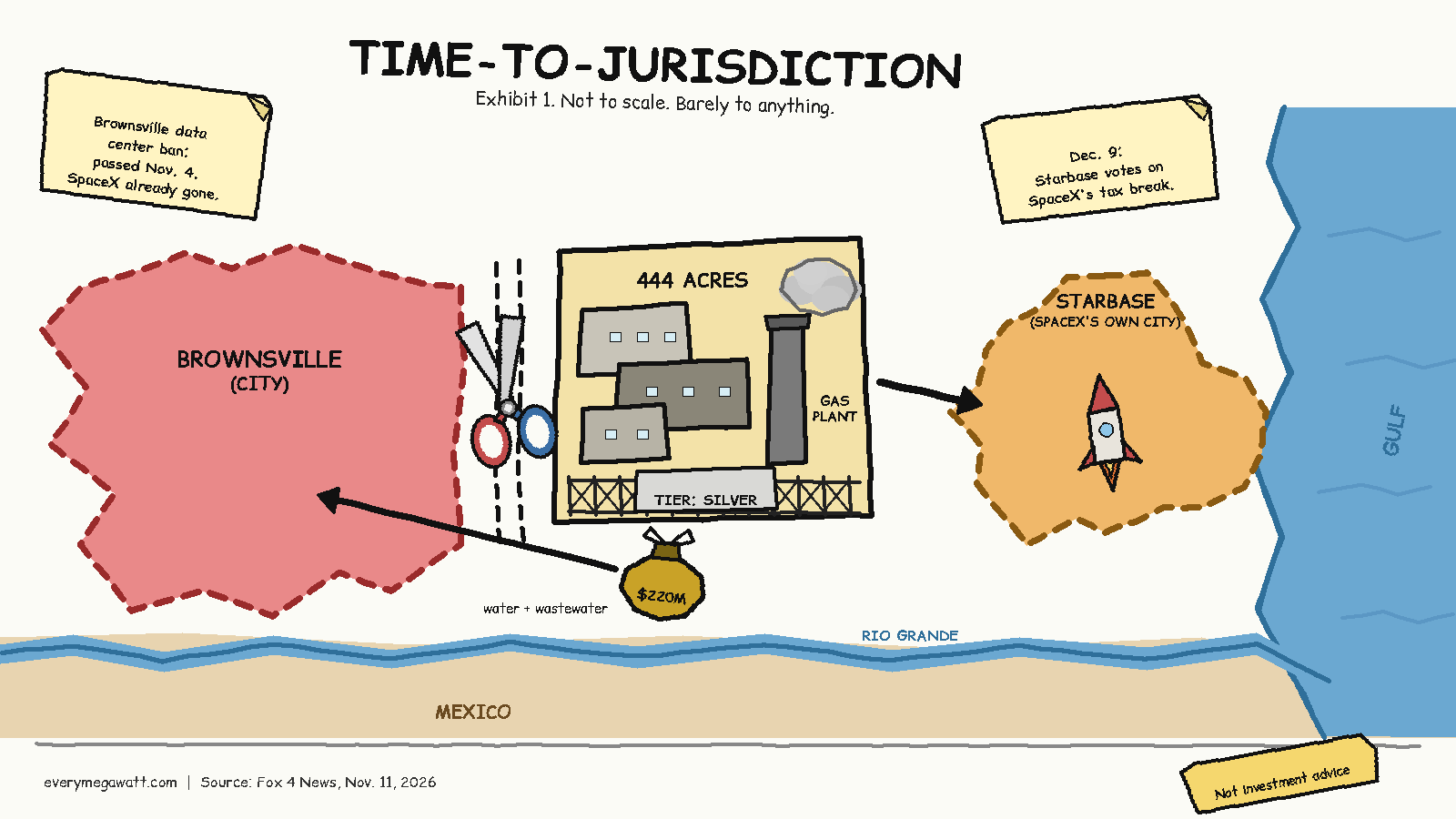
SpaceX is building a $24 billion data center and gas plant in Starbase, Texas. It sits on 444 acres that the city of Brownsville agreed to cut out of itself, for $220 million. One day the land was in the city. The next day it wasn't.
Today we are adding a new metric to the Datacenter Model: time-to-jurisdiction. For years everyone measured time-to-power, how long until you can plug in. SpaceX just proved the real bottleneck is a government that won't leave you alone. Time-to-jurisdiction is how fast you can fix that, and SpaceX now holds the record.
SpaceX did not get around the ban. It left before the ban existed. Brownsville removed the 444 acres from the city earlier this year; the 90-day ban on new data centers only passed on November 4. The land was then annexed by Starbase, SpaceX's own company town, which will hold a hearing on December 9 on SpaceX's tax break. SpaceX's town is voting on SpaceX's tax break.
SpaceX posted a negative time-to-jurisdiction. It left the city before the city had a rule.
We flagged this in Q2, back when it was still just "aggressive."
What actually happened
Here it is in order. Brownsville took the $220 million and removed the land. The land became unincorporated, then was annexed into Starbase, the company town. Months later Brownsville passed its ban, on territory it no longer had. Starbase now runs the December 9 hearing on the tax break. The campus never moved an inch. SpaceX didn't beat the rules. It moved the border, then it moved the town line.
And instead of waiting years in line to plug into the Texas power grid, SpaceX is building its own gas plant. So now it makes its own power, writes its own zoning, and, as far as our model can tell, runs its own weather.
How time-to-jurisdiction works
Old metric, time-to-power: months to years, mostly spent waiting for the grid. New metric, time-to-jurisdiction: the time between "the city has a rule" and "the city no longer covers your land." SpaceX did it in one vote.
We back-tested the metric across our whole coverage. Every other company scored infinity, because they are all still inside a city, following its rules. On a bottom-up basis we estimate SpaceX is now displacing 1.0 municipalities per gigawatt, against a sector average of zero.
Tier list
SpaceX moves up to Gold, on the best time-to-jurisdiction score ever recorded. Brownsville drops to "Not Rated," until it figures out where it currently is. The construction fence makes the tier list on its own, at Silver, ahead of several real companies.
We asked whether the campus would respect a future town vote. SpaceX did not respond, largely because we did not ask. The fence poured another slab while we were not talking, which our desk recorded as the only permit that ever mattered.
Risks
The December 9 hearing in Starbase goes badly and the land stays its own little country, with a gas plant, no garbage pickup, and presumably a plan to burn the garbage for a few extra megawatts, which our model counts as a win.
The larger risk is that the ban is bullish. The argument making the rounds is that a Texas crackdown on data centers keeps compute scarce, which is good for the company that already left. A ban that raises the valuation of the firm that escaped it is the cleanest outcome on the board.
Disclosure
The publisher owns IREN and CIFR. He does not own any city limits.
The rest, including which Texas counties are the easiest to leave, is for paid subscribers.
Every number in this report is real. SpaceX's $24 billion campus, and Brownsville's agreement to remove the land from the city, are reported by Fox 4 News. We did not make this up, which is the entire problem.


