Elon Musk Asked Where Hundreds of Billions in AI Working Capital Will Come From. His Own Lenders Just Asked Him to Keep the Collateral on Earth.
Replying to Francois Chollet on X, Musk warned that even a few months of power and cooling delays between paying for GPUs and earning revenue will trigger a cash crunch next year. The bond market is already pricing the gap.
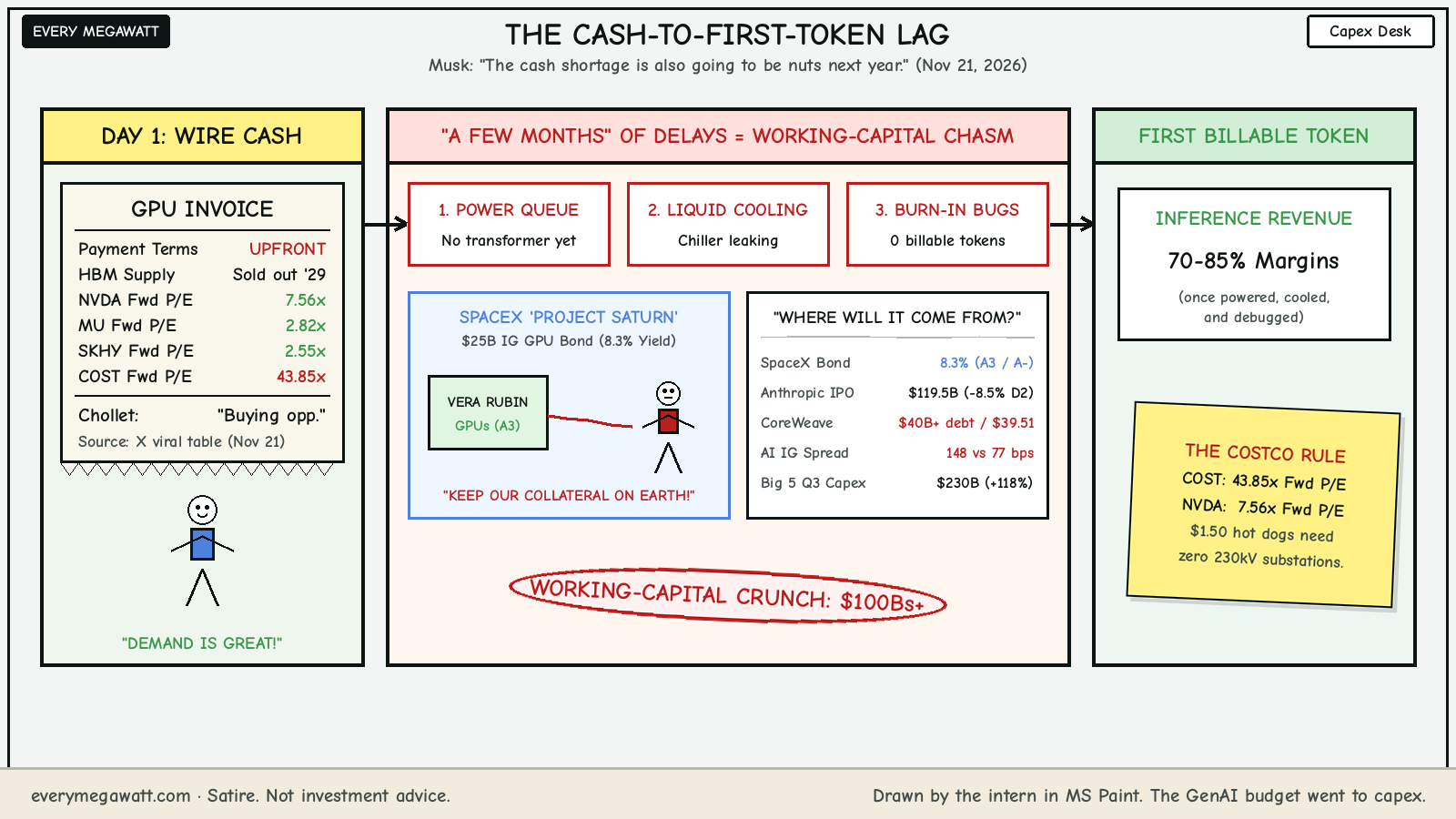
On Saturday afternoon, a chart showing memory and chip stocks at dirt-cheap prices went viral on finance Twitter. SanDisk sat at 2.18 times next year's profits. SK Hynix sat at 2.55 times. Micron sat at 2.82 times. Nvidia, after its worst week since 2008, sat at 7.56 times. Costco sat at 43.85 times.
AI researcher Francois Chollet shared the chart with a simple bull case. GPU rental prices keep rising. High-bandwidth memory is sold out through 2029. Frontier AI training demand doubles roughly every five months, and running AI models earns 70 to 85 percent margins. "Either you believe the AI buildout is over, that AI was a flash in the pan, and that the need for compute has already peaked," Chollet wrote, "or this a rare buying opportunity."
Two hours later, Elon Musk replied and summed up the entire credit market in two short paragraphs.
"Getting this amount of compute turned on, cooled and working reliably is incredibly hard," Musk wrote. "The cash shortage is also going to be nuts next year. Even cumulative industry delays of a few months between paying for compute and getting it reliable enough to generate revenue will mean hundreds of billions of incremental dollars just for working capital. Where will it come from?"
Both men are right, which is the catch. Demand is not the problem. The problem is what our Datacenter Model calls Cash-to-First-Token Lag: the months between wiring cash for servers and getting the building powered, liquid-cooled, and steady enough to bill a customer. During those months, sales are zero, interest bills keep running, and someone has to front the cash.
The Cash Crunch Is Already Here
This is not a guess about 2027. Wall Street spent the last ten days pricing this exact problem in real time.
At Nvidia's Berlin conference last month, as we covered in Jensen's Guide to How to Neocloud, Wall Street Journal reporting said Nvidia told neocloud operators its days as the industry's open checkbook were over. Future GPU orders would require upfront customer cash. That pushes the cash burden onto builders right as power transformers, cooling pipes, and server testing are stretching schedules out by months.
Look at who had to answer Musk's question this week alone:
| Borrower / Issuer | Structure (Nov 2026) | Size | Terms / Market Signal |
|---|---|---|---|
| SpaceX ("Project Saturn") | SPV GPU lease debt (Nvidia Vera Rubin NVL72) | ~$40B to $43B total ($25B IG bond) | Priced near 8.3% yield (345 bps over Treasuries); Moody's A3 / KBRA A- |
| Anthropic (`ANT`) | IPO + full greenshoe + supplier Class N placement | $119.5B ($93.5B IPO + $26B placement) | Closed Day 2 at $88.91 (-8.5%), wiping out most of the opening pop |
| CoreWeave (`CRWV`) | Unsecured debt + equity tape | $40B+ Q3 debt vs ~$21.8B market cap | Co-founder disclosed $30M personal bond buy on LinkedIn; stock fell 12% Friday to $39.51 |
| Big 5 Hyperscalers | Operating cash flow + corporate bonds | $230B Q3 capex (+118% YoY) | AI IG bond spreads widened to ~148 bps vs ~77 bps for non-AI IG corporates |
Even the biggest IPO in history felt the weight. Anthropic closed a record $93.5 billion IPO plus $26 billion from its own suppliers on Friday morning. By Friday afternoon, CNN reported shares had dropped 8.5 percent to $88.91 as the Nasdaq gave back its gains for the year.
Over in neoclouds, MarketWatch reported that CoreWeave co-founder Brian Venturo posted on LinkedIn that he personally bought $30 million of the company's October 2031 bonds (plain bonds do not require an SEC Form 4 filing). The stock jumped over 10 percent Thursday morning, reversed to close down 6 percent, and fell another 12 percent Friday to a 52-week low of $39.51. Buying your own bonds instead of your own stock says you expect the company to pay its bills, not necessarily that the stock is a bargain under $40 billion of debt.
Even Musk's Own Lenders Wanted a Leash
That brings us back to Musk's question: where will hundreds of billions in cash come from?
For SpaceX on Thursday, the answer was Apollo, Goldman Sachs, BlackRock, KKR, and a $4 billion anchor order from Pimco. According to Financial Times and Bloomberg reporting, SpaceX sold over $30 billion of its roughly $40 billion to $43 billion "Project Saturn" debt deal, led by a $25 billion bond backed by five-year leases on Nvidia Vera Rubin chips. Even with an investment-grade A3 rating from Moody's, lenders charged about 8.3 percent. That is more than a full point higher than SpaceX's older 2031 debt.
Lenders also asked for one unforgettable rule. Per the Financial Times, they sought safeguards stopping SpaceX from launching the pledged Nvidia chips into orbit for space data centers, for the simple reason that it is hard to repossess a GPU in space. SpaceX said the chips are for data centers on Earth, and it is unclear if the rule made the final papers. Still, when bond buyers have to specify which planet the collateral stays on, cash is no longer cheap.
What the Stock Prices Are Actually Saying
That is why Chollet's chart looks crazy at first glance and makes total sense on a second look.
Nobody on Wall Street thinks Micron at 2.82 times profits or Nvidia at 7.56 times lacks buyers. Investors are staring at a buildout that needs hundreds of billions upfront, months of power and cooling delays before the first dollar comes in, and a bond market charging 8.3 percent to the most famous rocket company on Earth. Costco, by comparison, takes your membership fee at the door and sells rotisserie chickens that do not need a high-voltage substation.
Every megawatt will be monetized, provided someone can cover the four months between paying for the rack and getting the chiller to stay on.
Sources
- - Elon Musk (@elonmusk) reply to Francois Chollet (@fchollet), X, Nov 21, 2026
- x.com/elonmusk/status/2124271725927903388 - Financial Times / Investing.com: SpaceX lenders seek safeguards against Musk sending AI chips into space ("Project Saturn", $25B IG bond at ~8.3%, A3/A-), Nov 19-20, 2026
- investing.com/news/stock-market-news/space… - Dealroom summary of FT / Bloomberg reporting on SpaceX Project Saturn ($40B+ package, Vera Rubin NVL72 leases, Apollo/Goldman/Pimco/BlackRock/KKR), Nov 20, 2026
- dealroom.co/news/other-yu0xh5-lenders-aim-… - MarketWatch / Morningstar: CoreWeave co-founder Brian Venturo's $30M personal purchase of 2031 unsecured bonds, Nov 19, 2026
- morningstar.com/news/marketwatch/202611191… - Macrotrends / MarketChameleon: CoreWeave (`CRWV`) Nov 20, 2026 close ($39.51, -12.0%, 52-week low $39.28)
- macrotrends.net/stocks/charts/CRWV/corewea… - Anthropic closing press release & CNN: $93.5B IPO + $26B placement, Day 2 close $88.91 (-8.5%), Nov 20, 2026
- cnn.com/2026/11/20/investing/us-stocks-ant… - Understanding AI: Big 5 hyperscaler Q3 2026 capex ($230B, +118% YoY), Nov 18, 2026
- understandingai.org/p/19-charts-that-expla… - TradingKey: AI investment-grade bond spreads (~148 bps vs ~77 bps non-AI IG), Nov 15, 2026
- tradingkey.com/analysis/stocks/us-stocks/2…

