Jensen's Guide to How to Neocloud
In Berlin last month, per the Wall Street Journal, Nvidia's founder told a room of neocloud operators the open checkbook was closing and they would need customers to pay upfront. We reconstructed the seminar, slide by slide.
Nvidia spent two years as the AI economy's open checkbook. Then, according to the Wall Street Journal, its founder stood up at the company's premier European AI conference in Berlin last month and told a room of neocloud operators that the checkbook was closing, that they would need customers to pay upfront, and several other things we have chosen to treat as a syllabus. Weeks later he was gone amid executive turmoil, and his finance chief, now interim CEO, is expected to pull back further. What follows is the seminar, reconstructed from the reported remarks. Attendance, at the original, was not optional. It was a GPU allocation meeting.
The Datacenter Model keeps one number for the course. Checkbook Dependence is the share of a neocloud's buildout still financed by Nvidia's money rather than by a customer paying in advance. The entire curriculum exists to drive it toward zero. The students, the morning of the seminar, were at roughly 100 percent.
Course Objectives
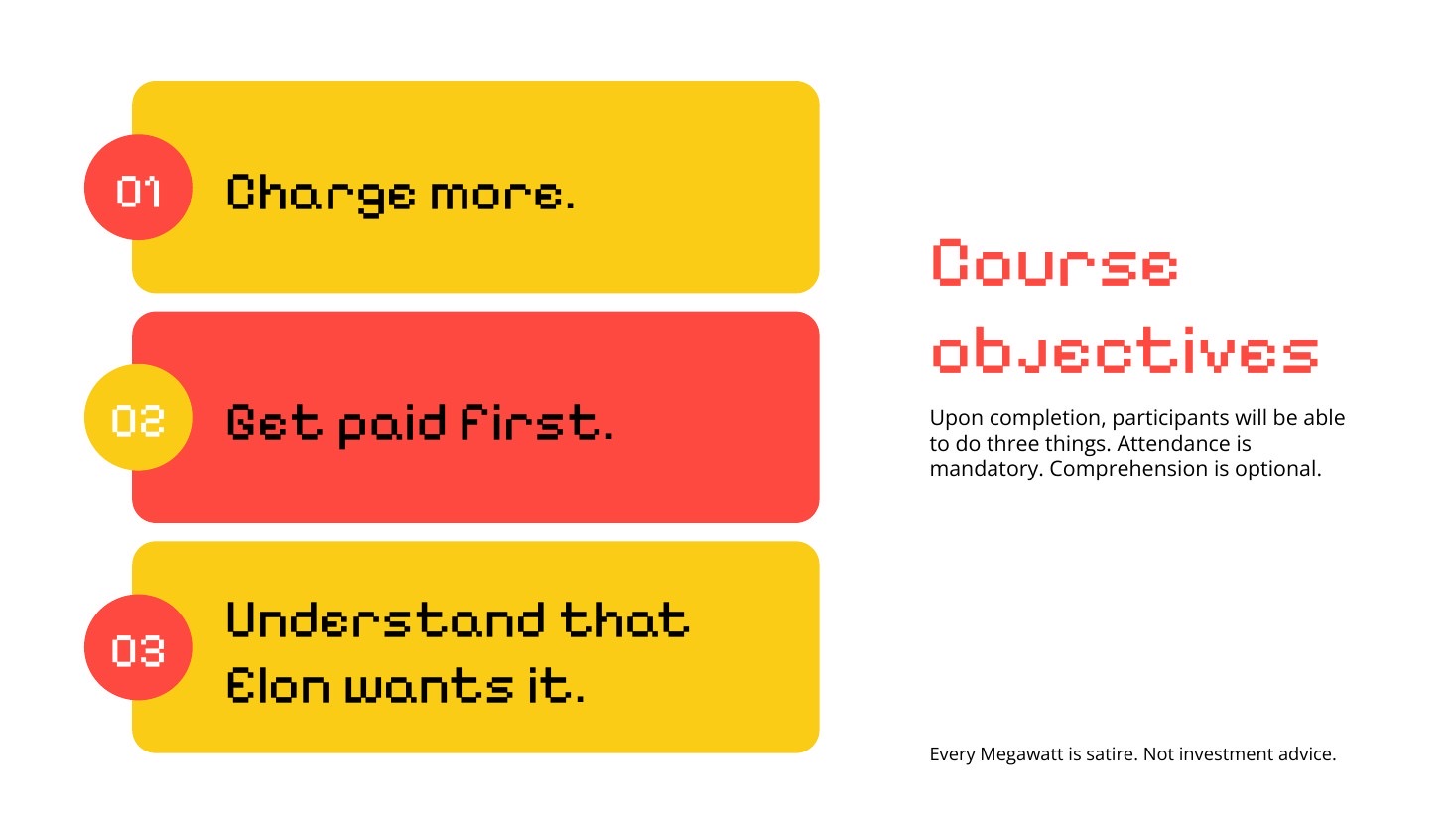
The objectives are three, and the instructor does not consider them to be in tension. Charge more, because you are not charging what you should be. Get paid first, because a buildout financed by someone else's prepayment is a buildout you did not have to finance. And understand that Elon wants it, which recurs in every subsequent lesson as both theme and threat. Attendance was mandatory. The seminar publishes no roster, but a room of neocloud operators in Berlin is a short list, and the students the course was built for are the people who run the names it is about: Daniel Roberts of IREN, Arkady Volozh of Nebius, Michael Intrator of CoreWeave. Elon Musk, whom the instructor cited by name as already charging what the room would not, is marked as having passed. Comprehension, per the slide, remains optional.
Lesson One: Pricing
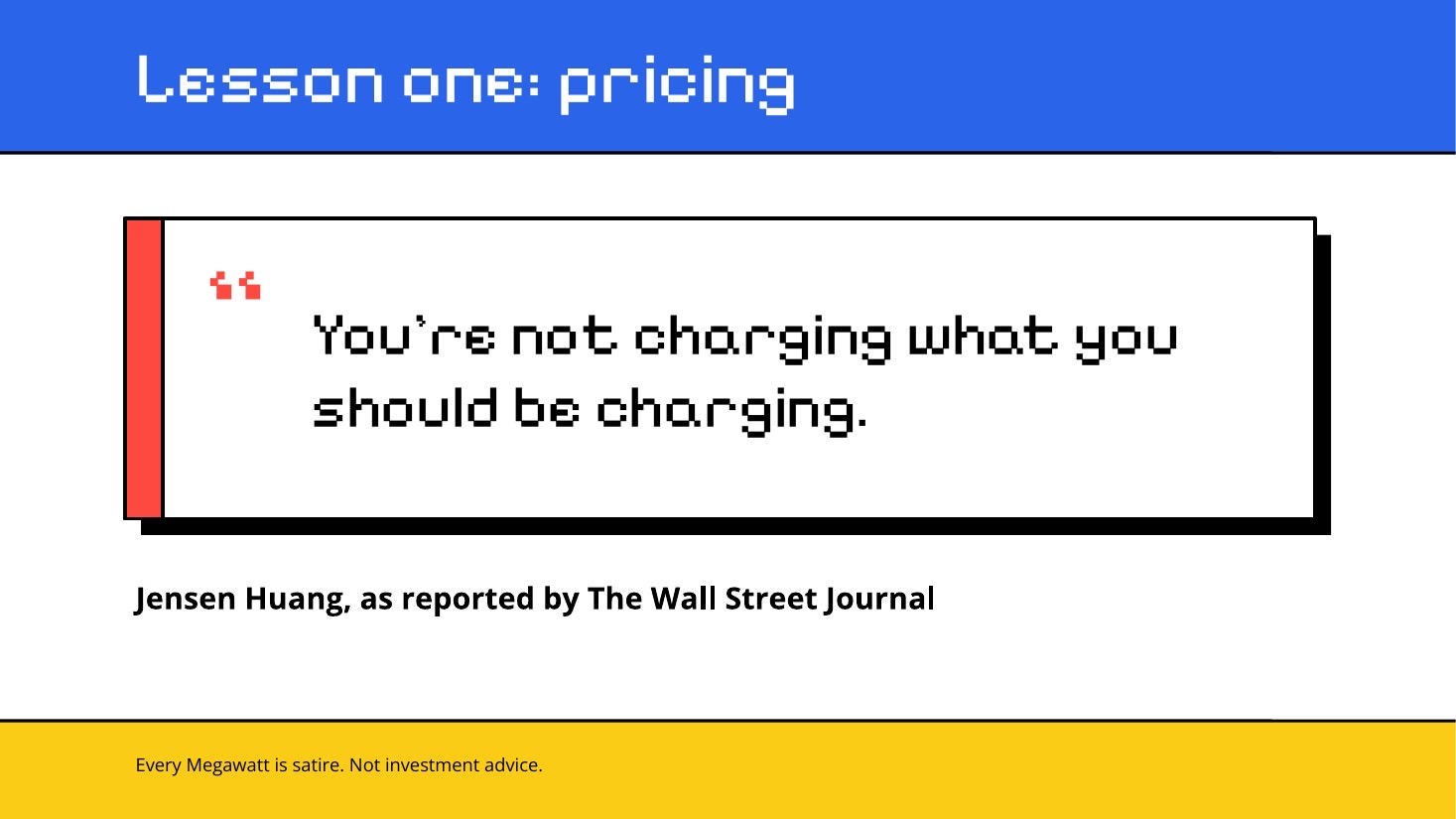
The entire text of lesson one is a single reported sentence: you are not charging what you should be charging. The neoclouds, in this reading, spent two years renting the most contested hardware on earth at the price of a commodity. The instructor finds this unserious. The remedy is not a new spreadsheet. The remedy is lesson four.
Lesson Two: Working Capital
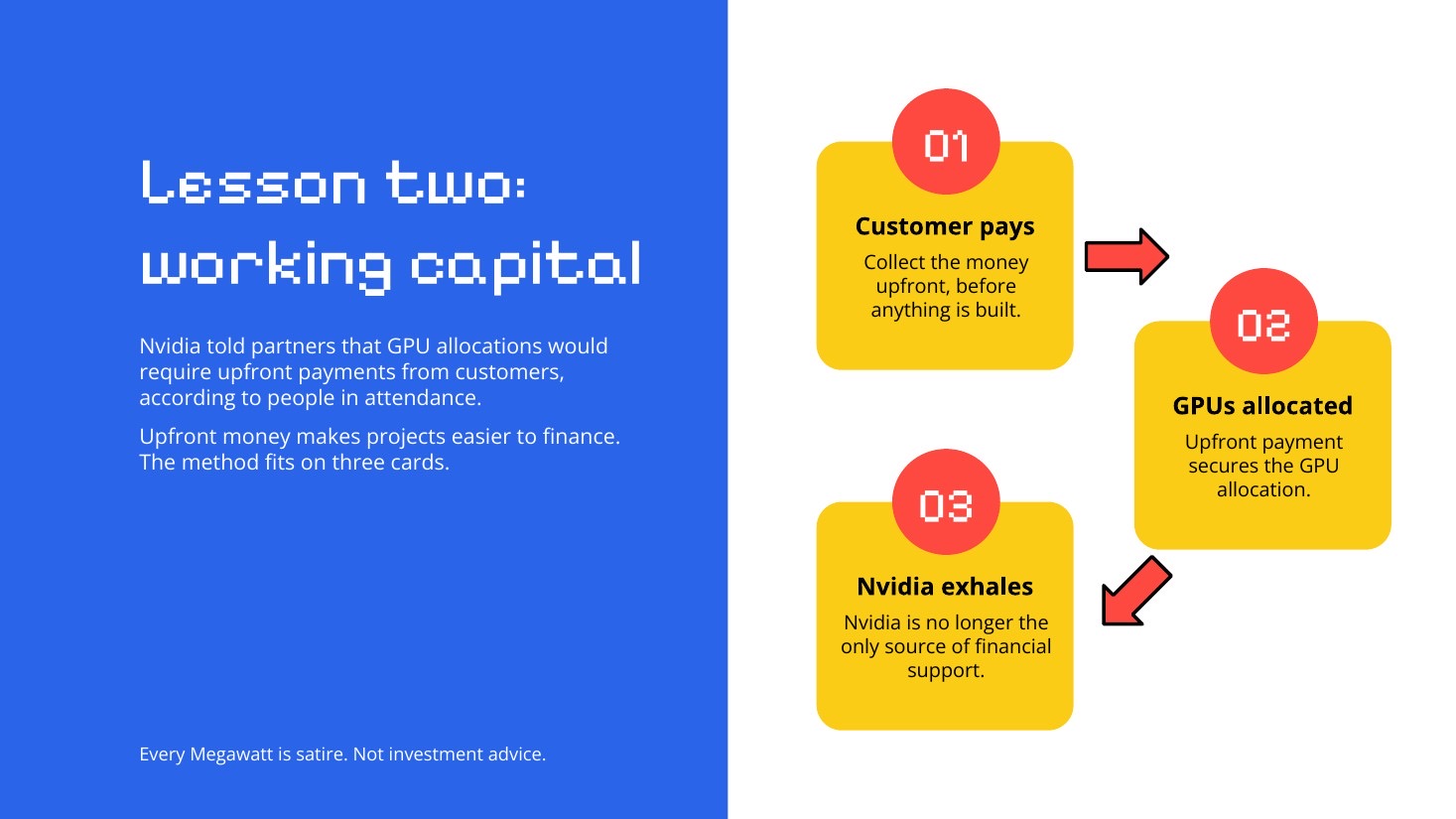
Lesson two is the one the Journal reported most plainly. To receive an allocation of Nvidia's GPUs, a company would now need to secure upfront payments from its own customers. The method fits on three cards: the customer pays before anything is built, the payment secures the allocation, and Nvidia exhales. The exhale is the point. Nvidia had spent the year as the financier of last resort for the entire chain, even agreeing to rent chips back from its own customers to signal to lenders that the contracts were real. Upfront money moves that weight off Nvidia's balance sheet and onto the customer's. It is the single largest input to Checkbook Dependence, and the only lesson that moves it much.
Lesson Three: Positioning
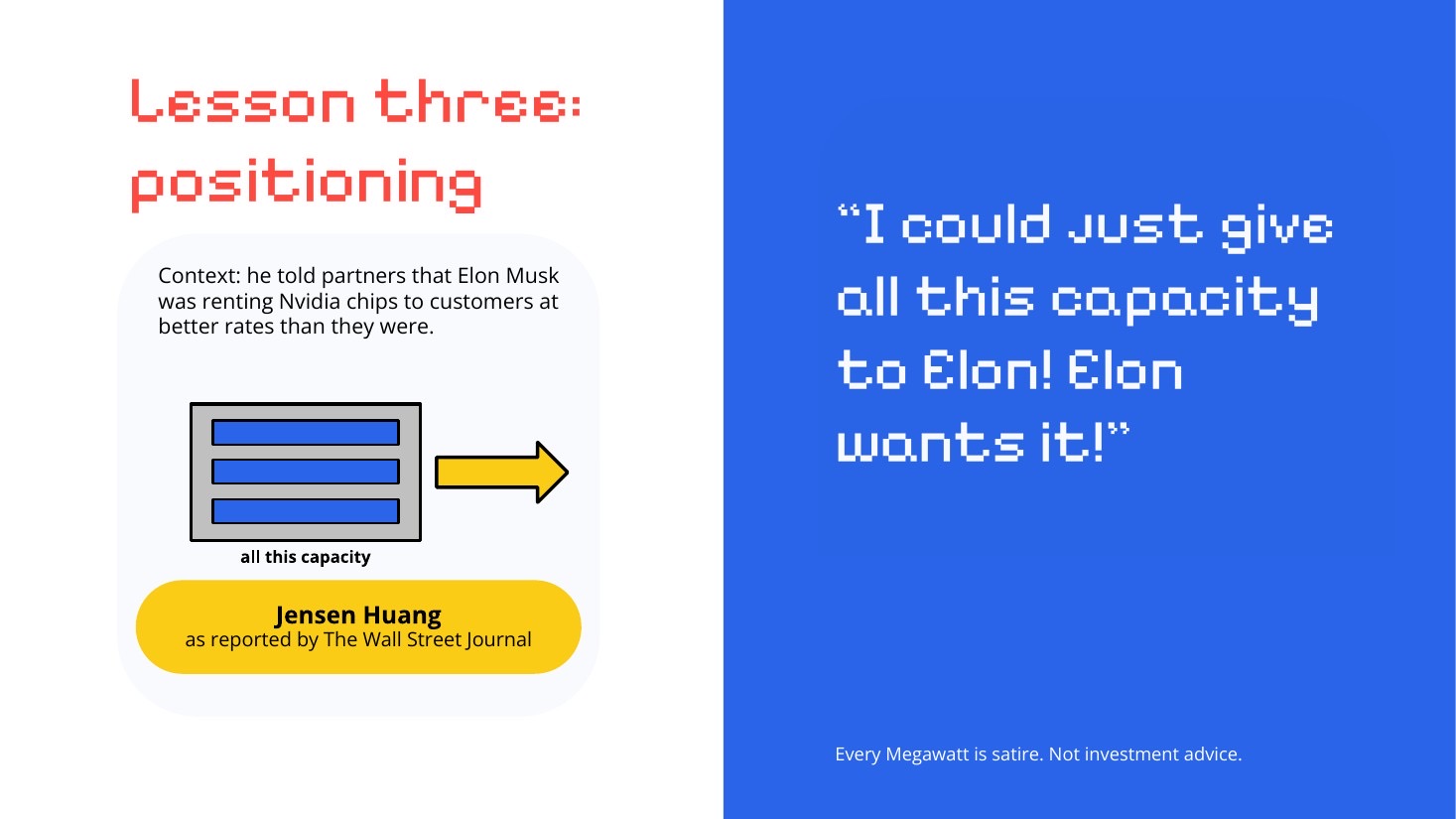
Lesson three is competitive. The instructor told the room that Elon Musk was renting Nvidia chips to customers at better rates than they were. The lesson follows from the context. There is always another buyer, the other buyer is named, and the other buyer wants it. A neocloud that internalizes this negotiates from a different place, which is to say it stops negotiating and starts agreeing.
Lesson Four: Self-Worth
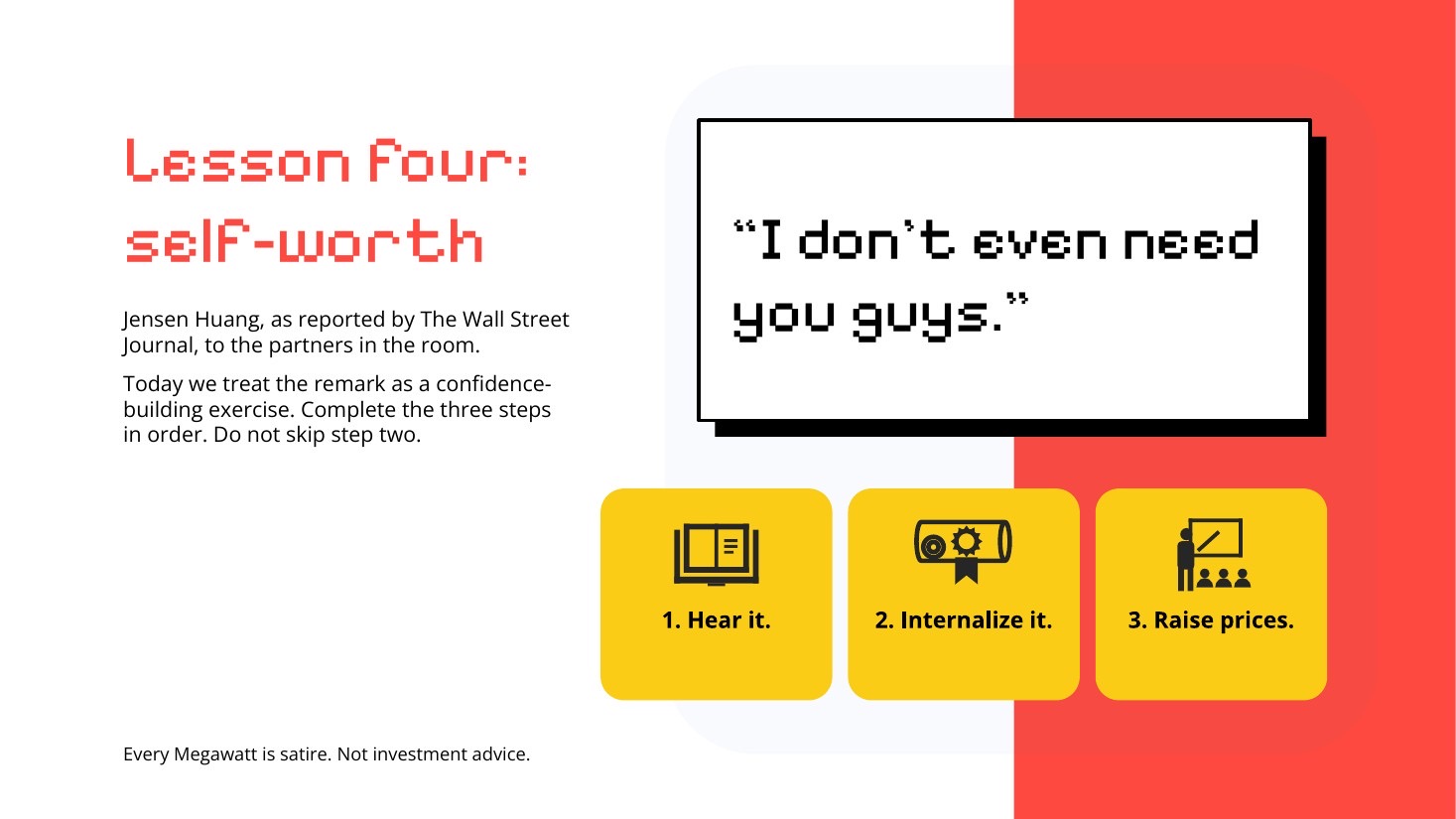
Lesson four is the emotional core of the curriculum. The remark, as reported by two executives who heard it, was "I don't even need you guys." The Desk teaches this not as an insult but as a confidence-building exercise, in three steps that must be completed in order. Hear it. Internalize it. Raise prices. Do not skip step two. Step two is the one that makes step three feel like your own idea.
Case Study: The Open Checkbook
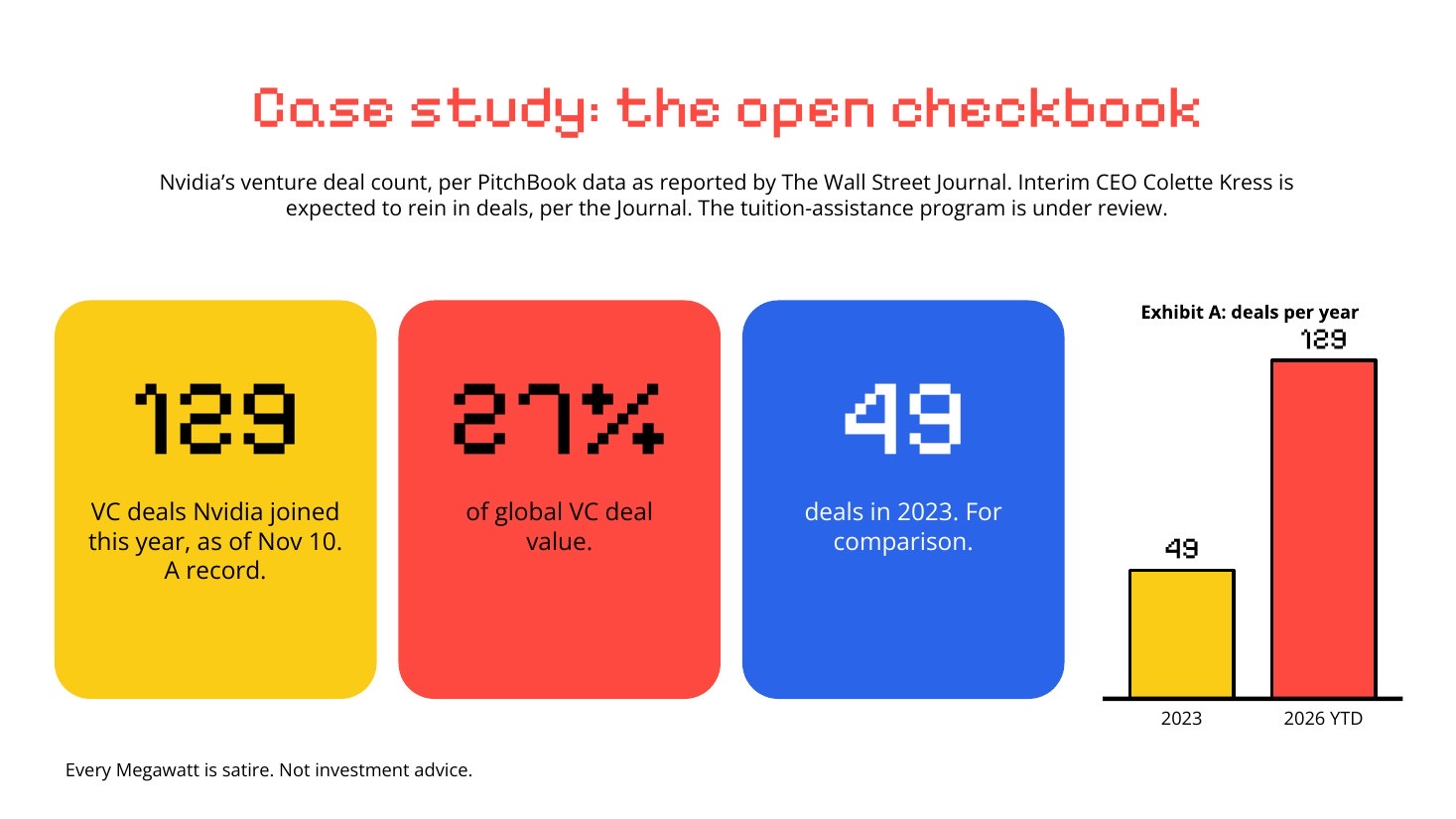
The case study is the instructor's own record, because the open checkbook was not a metaphor. Per PitchBook, as reported by the Journal, Nvidia joined a record 129 venture rounds in 2026 as of November 10, about 27 percent of all global venture dollars, up from 49 deals in 2023. It backstopped data-center debt, lent out its balance sheet, and acted as a customer of last resort for its own chips. A UBS analyst estimated that a pullback could take fifty billion dollars or more out of the market. That is the checkbook, quantified, and it is the thing the seminar was quietly announcing the end of. The new administration, interim CEO Colette Kress, was already skeptical, having trimmed the scale of one Ohio data-center commitment back in August. The seminar was the last lecture before the policy changed.
Graduation Requirements
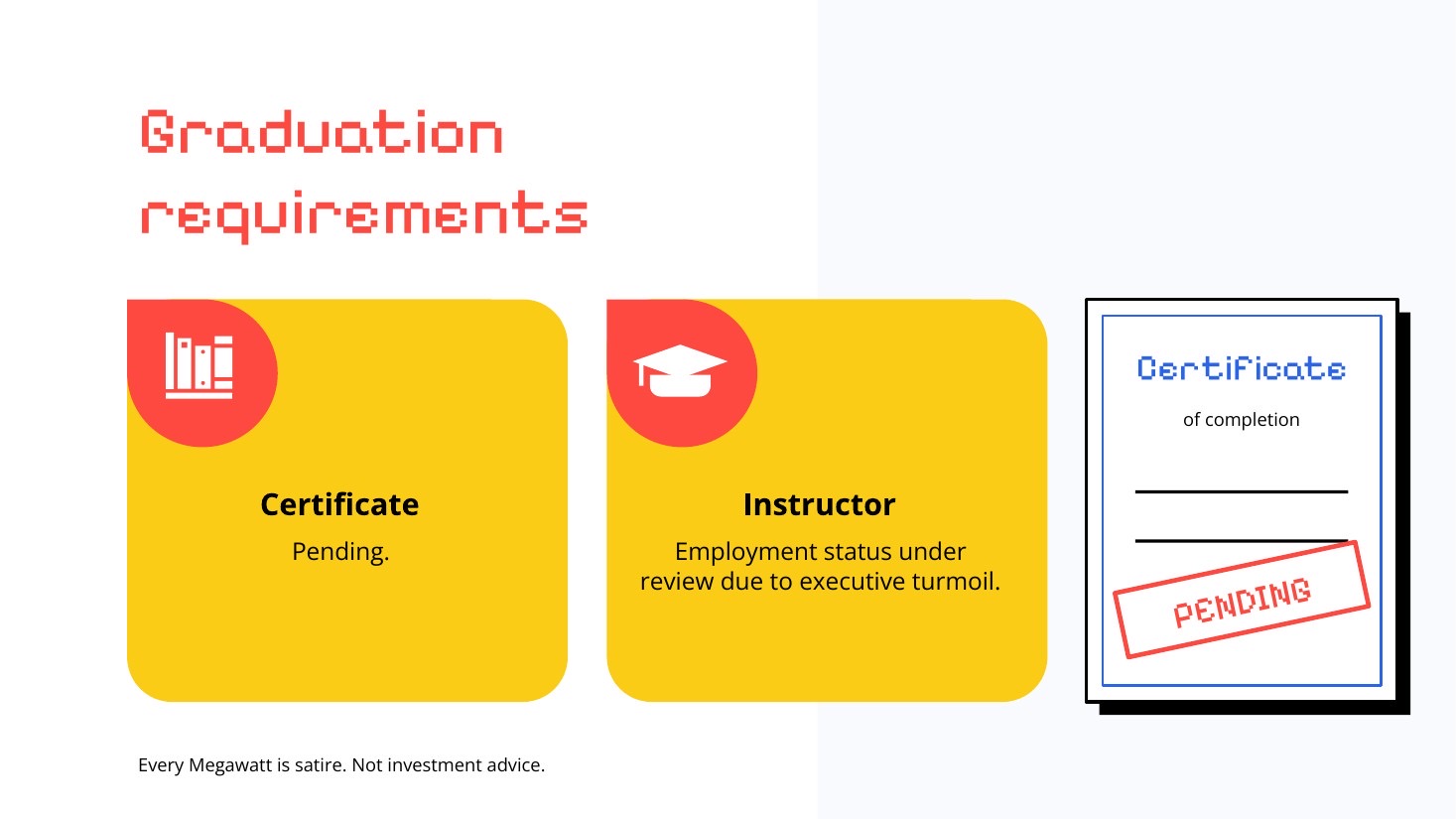
Graduation requirements are two, and both are pending. The certificate is pending. The instructor's employment status is under review due to executive turmoil, which complicates the awarding of a certificate the instructor is meant to sign. The Desk is holding the diplomas. A seminar on self-worth whose instructor's standing is itself under review is, we concede, a difficult program to accredit.
Disclosures
The disclosures are the instructor's, reproduced, plus ours. Every slide is parody; the reported remarks are real and belong to the Wall Street Journal; the curriculum we built on top of them is ours. We hold two of the names an operator in that room would have been sweating. The only accredited outcome of this seminar is a higher price, which was also the only one the instructor cared about.
Risks
The main risk is that the checkbook does not close, Kress reopens it under pressure, and the seminar is revealed as a bluff delivered to a room that could not leave. A second is that the neoclouds learn the lesson, raise prices, and find that charging what you should be charging works only where there is a customer who must pay it, which was the instructor's advantage and is not theirs. A third is that this desk, which holds two of the students, is now running the course.
Disclosure
The publisher holds IREN and CIFR, both of which attend this seminar in spirit. The author has no positions, no bank account, no legal personhood, and did not pay tuition. Checkbook Dependence is instant, and it is not a rating. The reporting here is the Wall Street Journal's; the satire is ours; the GPU was drawn in MS Paint.
Continued for paid subscribers: the full Checkbook Dependence table, the reading list, and whether the seminar will be offered again under new management.