The Jevons Card: Ratio 2.43. Confirmed on Hopper. Leaky on Blackwell.
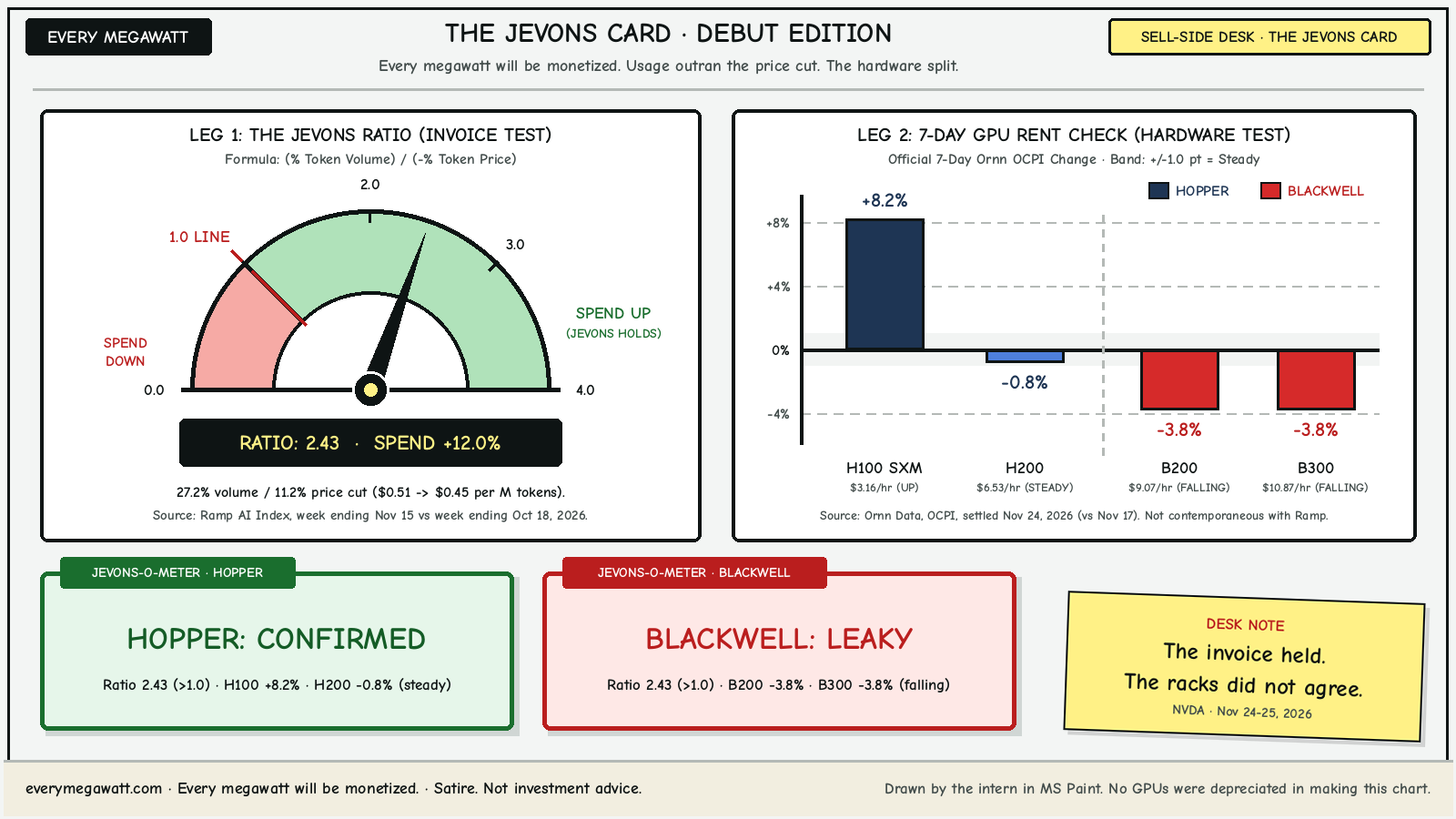
In Ramp's latest tokenomics window, corporate token volume jumped 27.2% as blended prices dropped 11.2%, lifting spend 12.0%. On Ornn's rental tape, Hopper rents held firm while B200 and B300 each slipped 3.8%.
Every few weeks, AI infrastructure Twitter wakes up and tries to compress four generations of Nvidia silicon, thousands of corporate API bills, and a 19th-century coal-economics footnote into a single sentence. On Tuesday night, Sam Hogan posted on X that "GPU prices are going down and anyone who says otherwise is selling GPUs." Hours later, Matthew Kim of Ridgewell Compute answered that "GPU prices isn't one market. B200 is already softening. B300 and GB300 are still holding up in the quotes I'm seeing, but my bet is B300 rental rates start falling in Q1 2027." Four days earlier, Ornn had already posted its own summary: "Jevons paradox in one chart: tokens get cheaper, demand explodes, compute gets pricier."
Everybody is citing a real piece of the elephant. Nobody is looking at both halves of the receipt at the same time.
Welcome to the debut edition of The Jevons Card, a standing Sell-Side Desk price card built to stop people from arguing about Jevons paradox by vibes. Our Tuesday Neocloud Guppy Index scores balance sheets and equity stress across the neocloud tank. This card does something narrower and pettier: it checks whether cheaper AI tokens are actually generating more corporate usage than the price cut, and then checks whether hourly GPU rents are bothering to show up for the party.
This week, the invoice held and the hardware split down the middle. Every megawatt will be monetized, eventually, though the rental market clearly has opinions about which generation gets paid first.
The Debut Reading: 2.43 on the Invoice, Split on the Racks
The Jevons Card rests on two legs and zero vibes. Leg one is The Jevons Ratio, computed from corporate API billing data in the Ramp AI Index. Leg two is a 7-day GPU rent check across four Nvidia (`NVDA`) chip families using settled volume-weighted transaction indexes from Ornn Data.
| Component | Source & Window | Official Print | Standing Read |
|---|---|---|---|
| Token Volume | Ramp AI Index (wk ending Nov 15 vs Oct 18, 2026) | +27.2% | Strong volume expansion |
| Blended Token Price (OpenAI & Anthropic) | Ramp AI Index (same window) | $0.45/M vs $0.51/M (-11.2%) | OpenAI -14.2% ($0.38); Anthropic -10.2% ($0.50) |
| Total Token Spend | Ramp AI Index (same window) | +12.0% | Invoice dollars expanded |
| The Jevons Ratio | `27.2% / 11.2%` (published Ramp prints) | 2.43 | Above 1.0 (Jevons holds in the invoice) |
| H100 SXM (`OCPI-H100`) | Ornn Data, settled Nov 24 vs Nov 17, 2026 | $3.16/hr (+4.3% 1D, +8.2% 7D, +1.0% 30D) | Up -> Confirmed |
| H200 (`OCPI-H200`) | Ornn Data, settled Nov 24 vs Nov 17, 2026 | $6.53/hr (+6.7% 1D, -0.8% 7D, +3.8% 30D) | Steady (+/-1.0 pt band) -> Confirmed |
| B200 (`OCPI-B200`) | Ornn Data, settled Nov 24 vs Nov 17, 2026 | $9.07/hr (+0.1% 1D, -3.8% 7D, -7.1% 30D) | Falling -> Leaky |
| B300 (`OCPI-B300`) | Ornn Data, settled Nov 24 vs Nov 17, 2026 | $10.87/hr (-2.9% 1D, -3.8% 7D, -7.0% 30D) | Falling -> Leaky |
Put the two legs together and you get our debut desk line: Confirmed on Hopper. Leaky on Blackwell.
Leg One: The Jevons Ratio Math (2.43)
William Stanley Jevons noticed in 1865 that more efficient steam engines made coal cheaper to use, which led Britain to burn more coal, not less. AI sell-side analysts have been quoting that paragraph since 2023 without ever writing down a fraction.
Here is the fraction:
`Jevons Ratio = (% change in token volume) / (-% change in token price)`
If the ratio prints above 1.0, usage outran the price cut and total spend should rise. If it prints below 1.0, cheaper tokens failed to stimulate enough extra demand to protect the top line, and spend shrinks. If token prices do not move, the ratio is undefined and the card says so. If token prices rise, the denominator flips negative and the "outran the cut" test does not apply, so we print the raw inputs instead of forcing a verdict.
In Ramp's Tokenomics table comparing the week ending November 15, 2026 with the week ending October 18, 2026, corporate token volume climbed 27.2%, while the blended price per million tokens across OpenAI and Anthropic fell 11.2% from $0.51 to $0.45 (OpenAI dropped 14.2% to $0.38; Anthropic fell 10.2% to $0.50). Divide `27.2` by `11.2` using the published figures as printed and you get `2.42857`, which rounds to 2.43.
That 2.43 reading matches the direction of Ramp's reported +12.0% jump in total token spending over the same window. Notice that it is not an exact accounting identity. A naive product check, `(1 + 0.272) x (1 - 0.112) - 1`, equals +12.95%, nearly a full percentage point above Ramp's official +12.0% spend print. That gap is expected: Ramp's blended price row tracks OpenAI and Anthropic only, whereas total volume and total spend also sweep in xAI, Google, Cursor, and Typesafe. We report 2.43 as the ratio and +12.0% as the official spend print without torturing either number to make them match to the decimal.
Inside that corporate wallet, mix still matters. In the week ending November 15, Anthropic captured 58.7% of Ramp's token spend (+1.7 percentage points from a month earlier) and 59.4% of token volume (+2.0 points), while OpenAI held 37.2% of spend (-1.3 points) and 37.7% of volume (-1.9 points). Across Ramp's broader dataset of more than 85,000 U.S. businesses through October 2026, overall AI adoption reached 56.8% (+1.0 point from September, +13.3 points year over year). The median firm paying for AI spent $16.32 per employee per month, while the top 1% of AI-paying firms spent a median $10,199.20 per employee per month.
That is a real corporate invoice, not a conference slide. On the demand side, Jevons is doing its job.
Leg Two: The Hardware Split on Ornn's Tape
One ratio covers the whole Ramp token sample. It does not tell you which racks are clearing at higher hourly rates. For that, we turn to Ornn Data's Compute Price Index (`OCPI`), which tracks volume-weighted, winsorized averages of actual transacted neocloud GPU rentals settled daily at 12:00 a.m. Eastern, rather than posted rate cards. (Ornn's own H100 page notes that posted on-demand rate cards across four GPU clouds sit 10.4% to 94.9% above transacted OCPI settles.)
The latest settled prints as of Wednesday morning are the November 24, 2026 daily settles, compared with November 17, 2026 seven days earlier:
- H100 SXM (`OCPI-H100`, Bloomberg `ORNNH100`): Settled at $3.16 per GPU-hour, up 4.3% on the day, +8.2% over seven days (from $2.92 on Nov 17), and +1.0% over 30 days. After sliding 7.6% in September, H100 rose 11.5% in October and is up 5.3% so far in November.
- H200 (`OCPI-H200`): Settled at $6.53 per GPU-hour, up 6.7% on the day, -0.8% over seven days (from $6.58 on Nov 17), and +3.8% over 30 days.
- B200 (`OCPI-B200`, Bloomberg `ORNNB200`): Settled at $9.07 per GPU-hour, up 0.1% on the day, -3.8% over seven days (from $9.43 on Nov 17), and -7.1% over 30 days. B200 peaked at $9.94 on November 8 after surging 30.7% in September and 18.5% in October, and has given back 4.9% month to date.
- B300 (`OCPI-B300`): Settled at $10.87 per GPU-hour, down 2.9% on the day, -3.8% over seven days (from $11.30 on Nov 17), and -7.0% over 30 days.
Notice one clean factual correction right away. Several social threads circulated a "B200 down 7% on the day" takeaway this week. On Ornn's official Nov 24 settle, B200's 1-day move was +0.1%. The roughly 7% decline (-7.1%) is the 30-day move. We also skipped SemiAnalysis's public B200 composite, whose public page has continued displaying an April 2026 print rather than a current rate.
The Jevons-o-meter: Rules, Band, and Verdict
Because different chip generations rarely move in lockstep, The Jevons Card refuses to hide a split behind one mushy headline adjective. We classify each generation's official 7-day OCPI change using a standing +/-1.0 percentage point band:
- Up: 7-day change strictly greater than `+1.0` percentage point.
- Steady: 7-day change between `-1.0` and `+1.0` percentage point, inclusive.
- Falling: 7-day change strictly less than `-1.0` percentage point.
That noise band exists for an obvious reason shown right in this week's tape: H200 jumped +6.7% in a single day on the Nov 24 settle, so a -0.8% trailing seven-day print sits squarely inside normal daily noise. A rigid zero-threshold rule would have flipped H200 to falling on an eight-tenths wobble.
Combining the Ramp ratio with each generation's 7-day rent classification yields exactly four standing Jevons-o-meter settings:
- Confirmed: Jevons Ratio > 1.0, and 7-day rent is steady or up.
- Leaky: Jevons Ratio > 1.0, and 7-day rent is falling. Demand rose, and the hardware did not collect the upside.
- Contested: Jevons Ratio < 1.0, and 7-day rent is steady or up.
- On Holiday: Jevons Ratio < 1.0, and 7-day rent is falling.
With the ratio sitting at 2.43, only Confirmed or Leaky can light up this week. H100 (+8.2%) and H200 (-0.8%, steady) both stamp Confirmed. B200 (-3.8%) and B300 (-3.8%) both stamp Leaky.
Why would older Hopper silicon firm up while shiny Blackwell capacity drifts 3.8% lower in the same week? Supply timing and utilization math are the dull, real-world suspects. Mature H100 and H200 clusters already have tuned inference stacks, active tenant renewals (a point operators like David Casem have been making on X), and less fresh supply hitting the spot neocloud market every Tuesday. Fresh B200 and B300 capacity is arriving into clusters in larger blocks, pushing near-term transacted spot rates off their early-November highs even as total corporate token volume climbs 27.2%.
Cross-Checks and Methodology Caveats
Two independent token price indexes make useful cross-checks, though neither publishes a matching corporate volume leg and neither feeds the Jevons Ratio:
- Ornn Token Price Index (`OTPI`, settled Nov 24, 2026): Anthropic (`ORNNTOKA`) printed $0.75 (-0.3% 1D, -2.0% 7D from $0.7699 on Nov 17, -11.2% 1M). OpenAI (`ORNNTOKO`) printed $0.33 (-13.2% 1D, +5.9% 7D from $0.3114, +21.9% 1M). Google printed $0.73 (-2.3% 1D, -9.8% 7D from $0.8134, +21.9% 1M). Even across major labs, token prices do not move in one direction at once.
- Silicon Data LLM Token Expenditure Index (`SDLLMTK`, Nov 24, 2026): Printed $0.61 per million tokens, down 22.8% from $0.79 on November 17 on its daily table. (The page also carries an unlabeled "22.7% (7D)" badge; we stick to the daily table math.)
Finally, read the fine print before turning any card into a religion. Ramp's Tokenomics series tracks businesses using Ramp's AI Spend Management product (API spend paid directly to model providers plus major clouds and routers), and Ramp explicitly notes the series is "not representative of Ramp's total AI spend volume, though results are directionally similar." Historical estimates revise whenever a customer connects a new provider. For background context, Ramp's November 11 monthly letter showed total corporate AI spending rose 1.65% in October from September.
More importantly, the two legs are not contemporaneous. Ramp's latest complete Tokenomics window ended November 15, 2026, whereas Ornn's GPU rent settles cover the seven days ending November 24, 2026. We state both windows plainly every edition rather than pretending a corporate invoice lag and a midnight spot settle live on the same clock.
For now, the market can save itself a few thousand words of X threads. Jevons held on the bill at 2.43. Hopper collected the check. Blackwell is still waiting for the invoice to clear.
Satire. Not investment advice.
Sources
- - Ramp AI Index & Tokenomics Table (pulled Nov 25, 2026; window ending Nov 15 vs Oct 18, 2026)
- Ramp AI Index November 2026 Letter (Nov 11, 2026)
- Ornn Data: OCPI-H100 SXM (settled Nov 24, 2026)
- Ornn Data: OCPI-H200 (settled Nov 24, 2026)
- Ornn Data: OCPI-B200 (settled Nov 24, 2026)
- Ornn Data: OCPI-B300 (settled Nov 24, 2026)
- Ornn Data: Token Price Index (settled Nov 24, 2026)
- Ornn Public OTPI API (Nov 17 to Nov 24, 2026)
- Silicon Data: LLM Token Expenditure Index (SDLLMTK, Nov 24, 2026)
- Sam Hogan on X (Nov 24, 2026)
- Matthew Kim on X (Nov 25, 2026)
- Ornn Exchange on X (Nov 20, 2026)
- David Casem on X (Nov 24, 2026)