Texas Lifted the Permit Freeze. The 474 GW Queue Is Still in Line.
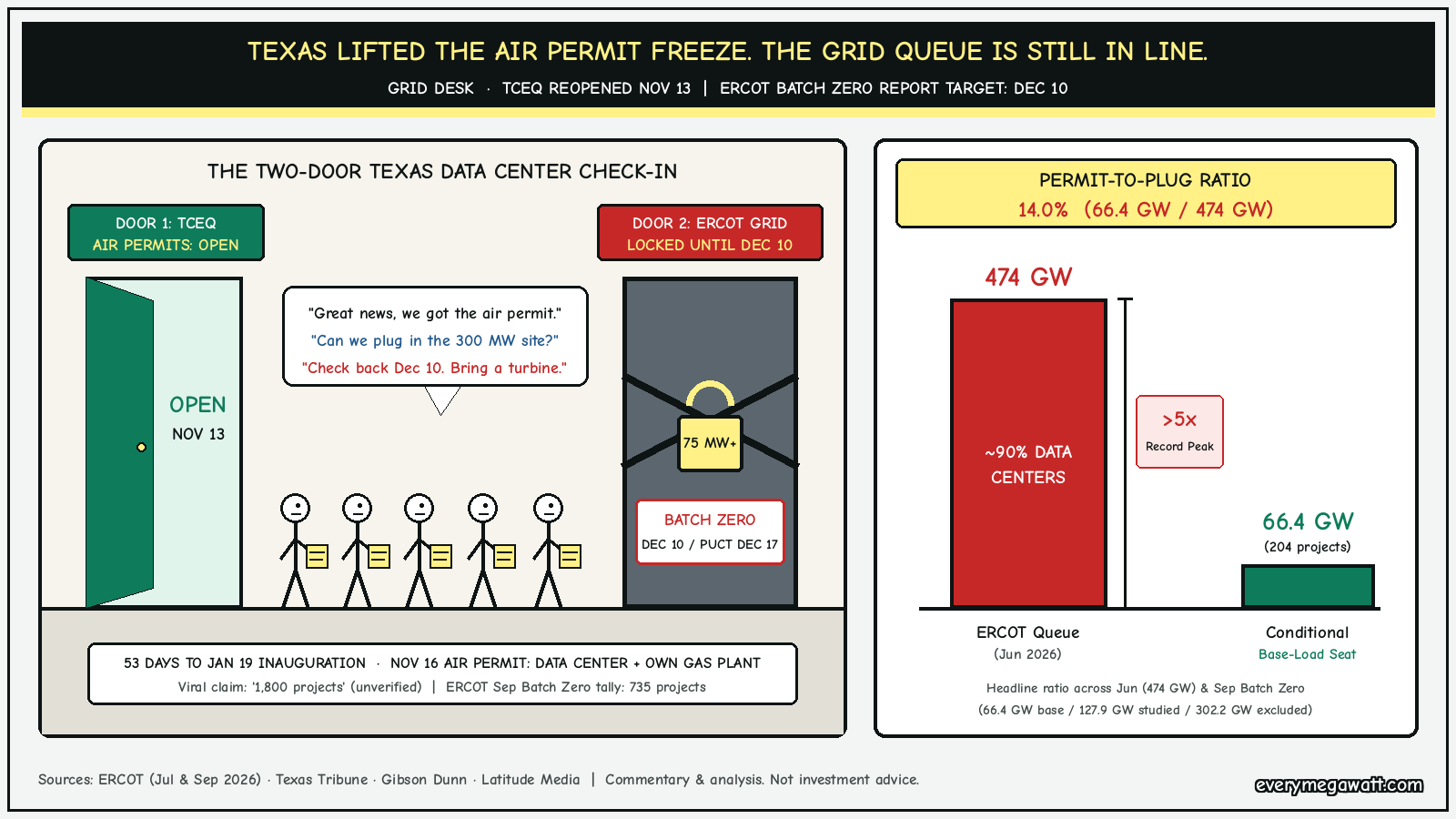
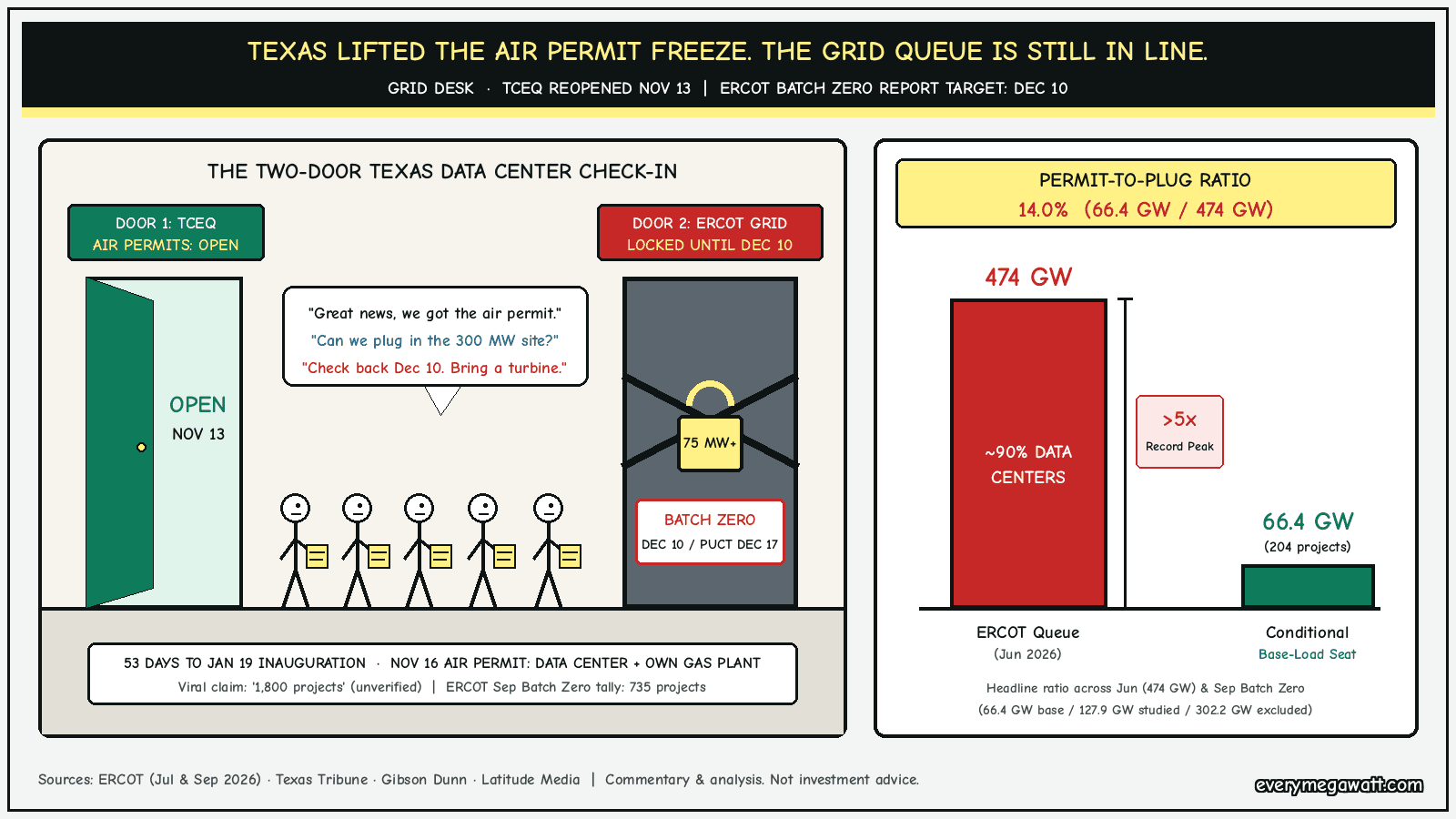
TCEQ reopened data center air permits; ERCOT's Batch Zero verdicts are not due until Dec 10, and 66.4 GW holds a conditional base-load seat.
Friday afternoon's viral AI infrastructure headline made Texas sound like it just flipped the breaker back on for the entire state.
A widely shared Polymarket post declared that Texas had lifted its freeze on "more than 1,800 data center projects," echoing a Friday Tom's Hardware report and the Financial Times Energy Source newsletter. That phrasing skips the only distinction that keeps servers powered on: Texas reopened the environmental permit window, not the grid plug.
What Actually Reopened (and What Stayed Shut)
Per the Texas Tribune and a regulatory timeline from Gibson Dunn, the Texas Commission on Environmental Quality (TCEQ) resumed its normal data center permit review after the Governor's office notified the agency on Nov 13 that ERCOT had finished gathering community-impact information. TCEQ spokesperson Laura Lopez told the Texas Tribune: "The agency has resumed its normal permit review process and will evaluate applications under all applicable state and federal laws and regulations." By Nov 16, TCEQ had already issued an air permit for a data center paired with its own gas-fired power plant.
That is the half of the process that lets a developer pour concrete and permit on-site generation. It is not an ERCOT grid connection.
On Aug 3, 2026, ERCOT paused its Batch Zero study process, delayed final classification of large loads, and halted approvals to energize data centers and crypto facilities of 75 MW or more, according to ERCOT's September Batch Zero board update. Per Gibson Dunn, ERCOT is still finishing its audit and is targeting Dec 10, 2026 to file its Batch Zero Eligibility Verification Report and Community Impact Review Report, ahead of an expected Dec 17 Public Utility Commission of Texas (PUCT) open meeting.
The Permit-to-Plug Ratio: 14.0%
In July 29 Senate testimony, ERCOT reported roughly 474 GW of large loads seeking interconnection as of June 2026, about 90% of them data centers. The Governor's August pause letter described that total as "more than five times Texas' record peak electricity demand for ERCOT," as quoted by Utility Dive.
While viral posts cite "more than 1,800 projects," ERCOT's September Batch Zero classification covers 735 projects across three buckets (also tracked by Latitude Media):
| ERCOT Batch Zero Bucket (Sep 2026) | Projects | Requested Load | Status |
|---|---|---|---|
| Conditionally Included (Base Load) | 204 | 66.4 GW | Holds a conditional grid seat |
| Conditionally Included (Studied Load) | 158 | 127.9 GW | Subject to further grid study |
| Excluded | 373 | 302.2 GW | Shut out of Batch Zero |
Because the 474 GW figure comes from ERCOT's June snapshot and the Batch Zero buckets come from September (summing to 496.5 GW), they are not a single reconciled ledger. Put the two headline figures side by side anyway, and the Grid Desk gets the Permit-to-Plug Ratio: 66.4 GW / 474 GW = 14.0%. For every 100 MW chasing an air permit today, roughly 14 MW holds a conditional base-load seat on the grid.
The 53-Day Filing Sprint and the Forward Curve
That math explains the rush. There are 53 days between Nov 27 and Jan 19, 2027, when Gov.-elect Gina Hinojosa takes office after campaigning on blocking new data center construction until lawmakers pass stricter rules, while the 90th Texas Legislature convenes Jan 12. Developers with shovels ready are not waiting to find out how Batch Zero lands; permitting a data center alongside its own gas-fired plant, like the Nov 16 approval, is the cleanest hedge when the substation door is still locked.
The power market is watching the calendar just as closely. Jefferies analysts, cited by Latitude Media, expect "the most plausible policy outcome is a legislative compromise that codifies consumer protections and sets guardrails on large-scale development," and note that Texas forward wholesale power is already priced assuming roughly 6 GW per year of grid-connected data centers. In other words, the most valuable data centers in Texas right now are the ones already baked into the futures curve and not yet plugged in.
Every megawatt will be monetized, eventually. For now, Texas developers have an air permit, a gas-turbine quote, and a very crowded waiting room until Dec 10.
Commentary & analysis. Not investment advice.