Taiwan Voted for Nuclear. TSMC's Meter Did Not Wait for the Count.
National Referendum No. 22 passed 7.43 million to 4.56 million on Saturday. Maanshan's earliest restart is 2028, while TSMC already burned 28.77 TWh in 2025.
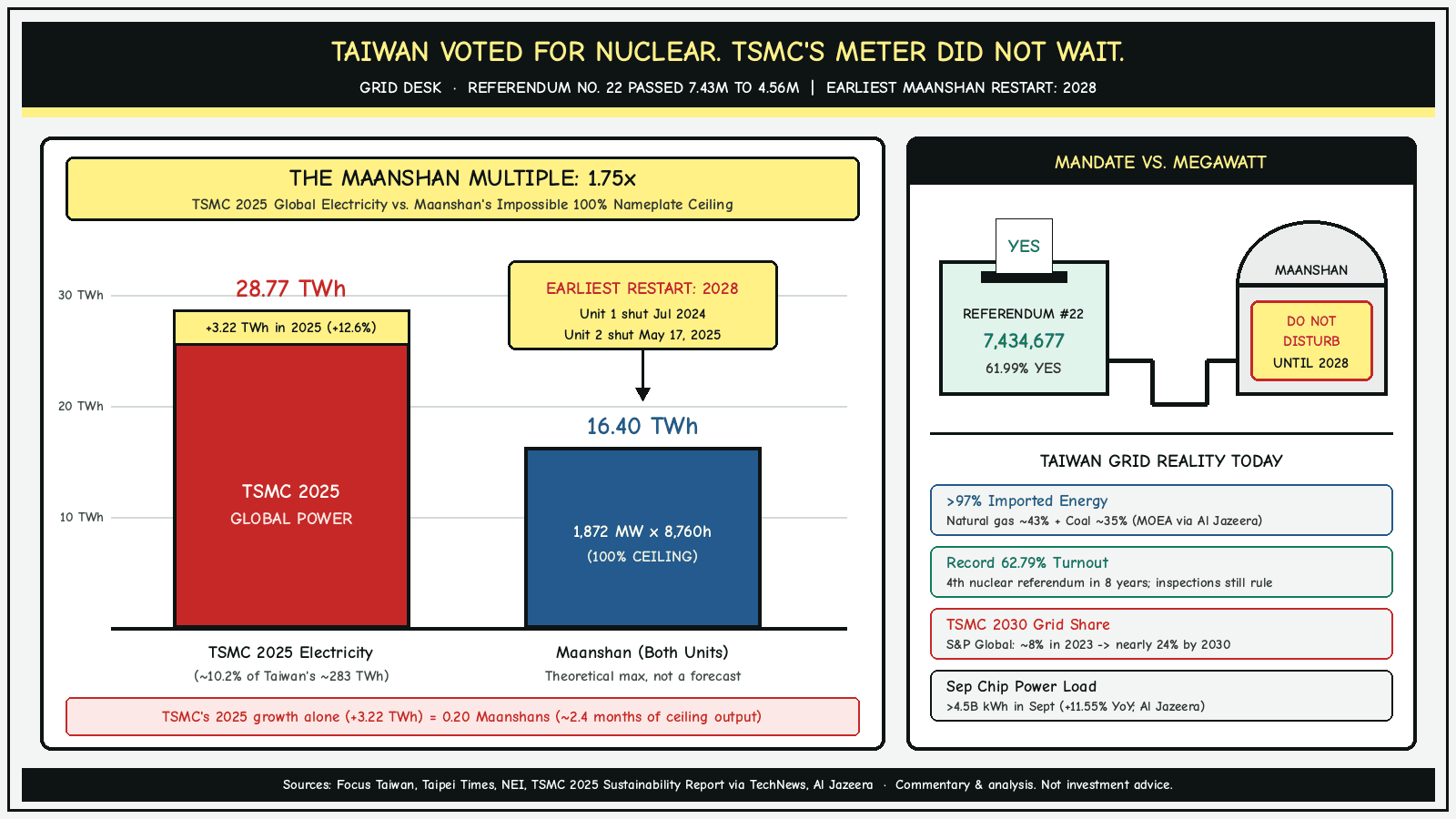
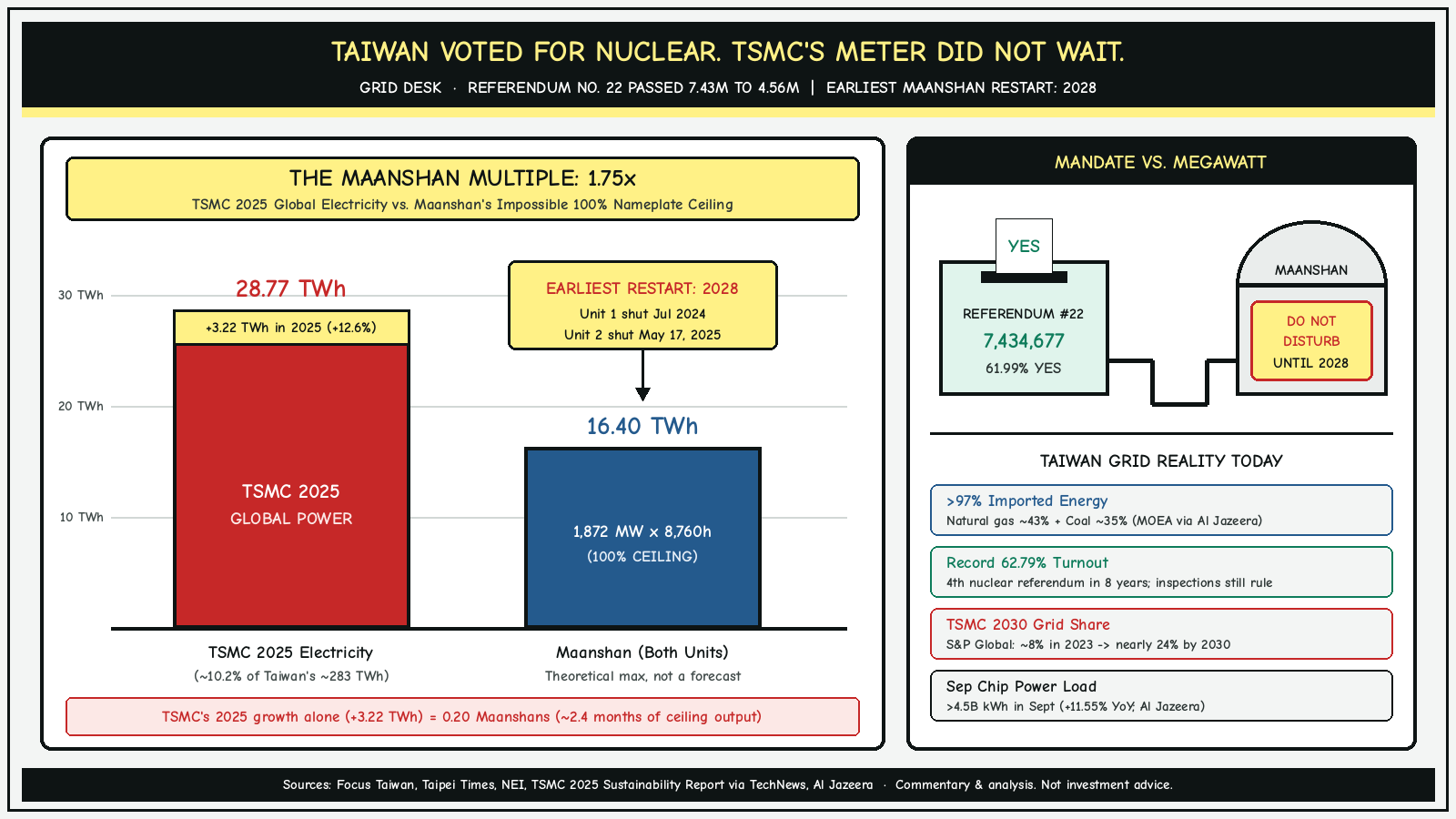
Taiwan's voters delivered a clear mandate on Saturday to revive nuclear power, passing National Referendum No. 22 by 7,434,677 votes to 4,557,768.
The ballot box moves on election night. Nuclear safety inspections do not.
According to Focus Taiwan (CNA) and Taipei Times, the referendum cleared both statutory hurdles easily, taking 61.99 percent of valid votes and 37.17 percent of Taiwan's 20,003,835 eligible voters on record 62.79 percent turnout. That ends a decade-long policy frame on paper. On the grid, however, the vote neither automatically repeals existing statutes nor switches a single turbine back on. The Cabinet said it respects the result, will continue advancing renewables, and will proceed on nuclear power based on safety, a waste solution, and social consensus.
Meanwhile, the power meter running the world's leading-edge AI silicon does not wait for regulatory schedules. Every megawatt will be monetized on the island, whether it arrives from a restarted reactor in 2028 or an LNG carrier docking next week.
The Maanshan Multiple: 1.75x
Start with the physical ceiling of the most likely restart candidate. The Maanshan nuclear station consists of two 936 MWe pressurized water reactors, totaling 1,872 MW of nameplate capacity. Unit 1 shut down in July 2024 and Unit 2 closed on May 17, 2025, leaving Taiwan with zero operating nuclear reactors after Kuosheng's two 985 MWe boiling water reactors retired in 2021 and 2023.
Taiwan's Nuclear Safety Commission has cleared Taipower's preliminary restart plan for Maanshan, according to Nuclear Engineering International, but safety inspections and formal regulatory reviews mean the earliest Maanshan could resume generation is 2028. Restart costs and any firmer operating date have not been disclosed.
Now compare that 2028 supply ceiling against one company's demand curve. If both Maanshan units ran at an impossible theoretical 100 percent of nameplate capacity for all 8,760 hours of a year, a hard mathematical ceiling rather than a forecast, they would generate 16.40 TWh annually.
Per TechNews calculations on TSMC's 2025 Sustainability Report, TSMC consumed 22.99 billion kWh of non-renewable electricity plus 5.78 billion kWh of renewable electricity in 2025, totaling 28.77 TWh across global operations. That was up 12.6 percent from 25.55 TWh in 2024.
| Metric | Figure | Source & Context |
|---|---|---|
| Referendum No. 22 vote | 7,434,677 Yes / 4,557,768 No | CEC via Taipei Times (61.99% valid; 62.79% turnout) |
| Maanshan nameplate capacity | 1,872 MW (2 x 936 MWe PWRs) | Nuclear Engineering International (earliest restart: 2028) |
| Maanshan theoretical max output | 16.40 TWh / year | 1,872 MW x 8,760 hrs (100% ceiling, not a forecast) |
| TSMC 2025 electricity use | 28.77 TWh (global) | TechNews on TSMC 2025 Sustainability Report (+12.6% YoY) |
| The Maanshan Multiple | 1.75x | 28.77 TWh / 16.40 TWh theoretical ceiling |
| TSMC 2025 YoY demand addition | +3.22 TWh | Equal to 0.20 Maanshans (~2.4 months of ceiling output) |
Divide TSMC's 2025 consumption by Maanshan's theoretical ceiling and you get a Maanshan Multiple of 1.75. Even the single-year increase alone, 3.22 TWh, equals 20 percent of a full-output Maanshan, or roughly two and a half months of maximum reactor output added every twelve months.
TSMC has not commented on Saturday's referendum result. Chairman C.C. Wei summed up the company's power reality cleanly in its sustainability report, quoted in Chinese by TechNews (translated here): "Electricity drives token output, and tokens create intelligence."
Baseload by Boat
Strip away electoral narratives and Taiwan's grid debate reduces to fuel logistics and tenant concentration.
Taiwan imports more than 97 percent of its energy, with natural gas supplying roughly 43 percent of electricity generation and coal supplying about 35 percent, according to Ministry of Economic Affairs data cited by Al Jazeera. That means the primary energy backbone behind the world's AI accelerators depends on continuous maritime shipments of LNG and coal. Proponents of the referendum emphasized that nuclear fuel rods can be stockpiled far more easily than liquefied natural gas, per Focus Taiwan.
At the same time, semiconductor load keeps climbing faster than the overall grid. TechNews puts TSMC's 28.77 TWh global usage alongside roughly 283 TWh of total Taiwan electricity consumption in 2025 (about 10.2 percent). Taiwan's semiconductor industry as a whole consumed more than 4.5 billion kWh in September alone, up 11.55 percent year over year, per Al Jazeera. S&P Global previously estimated TSMC's share of Taiwan's electricity at roughly 8 percent in 2023 and projected it could approach 24 percent by 2030.
At nearly a quarter of a national grid, a foundry stops looking like a utility customer and starts looking like the co-signer on the entire power system.
Saturday's vote opens the policy lane to bring Maanshan back online, and potentially revisit Kuosheng later. For AI hardware supply chains, the calendar takeaway is simpler: nuclear restarts are a 2028-and-beyond hedge. Between now and then, Taiwan's fabs run on gas tankers, coal ships, renewables, and whatever transmission reserve Taipower can keep upright while token demand keeps compounding.
Every megawatt will be monetized. Until Maanshan spins back up, Taiwan is paying the LNG bill to prove it.
Sources
- - Focus Taiwan (CNA), Nov 28, 2026: Referendum No. 22 text, result, and Cabinet response
- Taipei Times, Nov 29, 2026: CEC final vote count (7,434,677 yes / 4,557,768 no), 61.99% valid share, 62.79% turnout
- Nuclear Engineering International: Maanshan 2 x 936 MWe ratings, preliminary restart clearance, earliest restart 2028, Kuosheng closures
- TechNews Taiwan, Aug 24, 2026: TSMC 2025 Sustainability Report power totals (28.77 TWh, +12.6% YoY), MOEA 283 TWh comparison, C.C. Wei quote
- Al Jazeera, Nov 27, 2026: MOEA energy import (>97%) and gas/coal shares, S&P Global 2023-2030 TSMC grid share estimate, September semiconductor power (+11.55% YoY)
- Commentary & analysis. Not investment advice.