Korea Broke Ground on 2.4 GW of AI. The Building Is the Cheap Part.
GS Group pegs Donghae construction at about 30 trillion won and the full campus, GPUs and memory included, at up to 120 trillion won. The first 100 MW is targeted for Q2 2028.
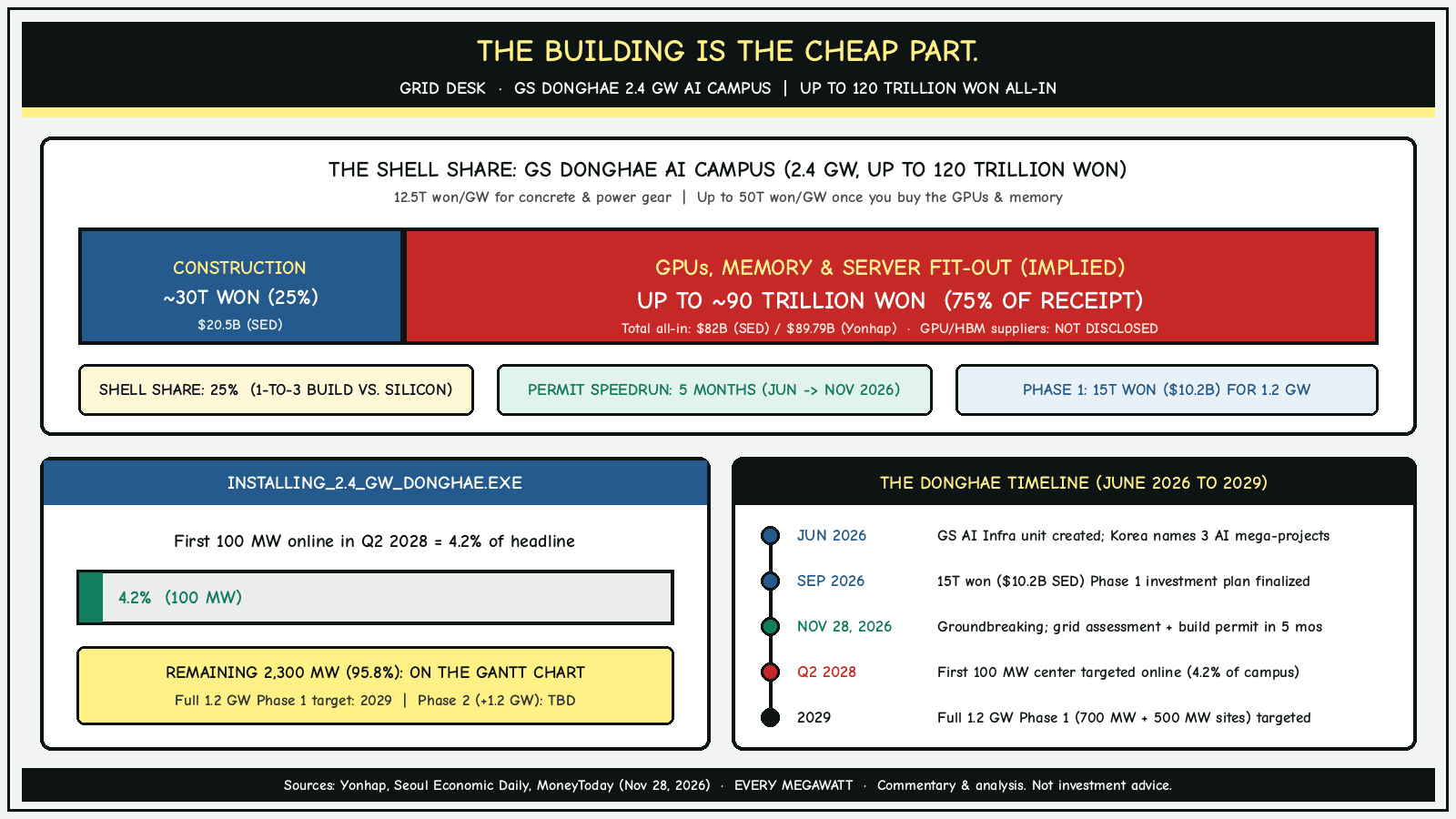
GS Group broke ground on Saturday morning on a 2.4 gigawatt AI data center campus in Donghae, on South Korea's east coast, with a headline figure big enough to wake up a quiet weekend tape: up to 120 trillion won all in.
That total converts to roughly $82 billion per Seoul Economic Daily and $89.79 billion per Yonhap, depending on the exchange rate used. Either way, the most useful number in the announcement is not the 120 trillion won ceiling. It is the 30 trillion won construction bill sitting underneath it.
At 30 trillion won ($20.5 billion per Seoul Economic Daily) for 2.4 GW of civil works, power gear, and shells, the building is only 25 percent of the receipt. The other 75 percent, up to 90 trillion won, is the GPUs, memory, and server hardware required to turn concrete into compute. Every megawatt will be monetized, eventually, right after somebody pays triple the building cost to fill the racks.
The Shell Share: 25 Percent Concrete, 75 Percent Silicon
GS Group's math is unusually consistent across both phases. In September, the conglomerate finalized a 15 trillion won ($10.2 billion per Seoul Economic Daily) investment plan for the 1.2 GW first phase. Scale that to the full 2.4 GW campus across two equal 1.2 GW phases, and the construction rate holds steady at 12.5 trillion won per gigawatt.
Add GPUs and memory, and the all-in estimate jumps to as much as 50 trillion won per gigawatt.
| Line Item | Won Estimate | Reported USD | Per GW (Won) | Share of All-In |
|---|---|---|---|---|
| Phase 1 construction plan (1.2 GW) | 15 trillion won | $10.2B (SED) | 12.5T won/GW | Phase 1 shell |
| Full campus construction (2.4 GW) | ~30 trillion won | $20.5B (SED) | 12.5T won/GW | ~25% (The Shell Share) |
| GPUs, memory & server fit-out (implied) | Up to ~90 trillion won | ~$61.5B-$69.3B | Up to 37.5T won/GW | ~75% |
| Full campus all-in total (2.4 GW) | Up to 120 trillion won | $82B (SED) / $89.79B (Yonhap) | Up to 50T won/GW | 100% |
That 1-to-3 split between physical plant and silicon is the defining cost structure of modern AI infrastructure. South Korea happens to be home to two of the world's three high-bandwidth memory manufacturers, which means the single priciest line item on a hyperscale AI receipt is a category the country already exports at scale. Even so, GPU and memory suppliers for Donghae have not been disclosed.
What has been named is the industrial roster behind the building itself. Seoul Economic Daily lists LS Electric, POSCO, LG Uplus, and Honeywell Technologies across equipment procurement, design, and operations. Ceremony exhibits featured LS Electric power gear, LG Electronics cooling systems, and AI servers from Elice Group.
The Five-Month Permit Speedrun
If the cost split looks familiar to anyone tracking U.S. neocloud capex, the permitting calendar does not.
According to Seoul Economic Daily, GS formed a dedicated unit, GS AI Infra, in June 2026 and cleared permitting, including a power grid impact assessment and construction approval, in five months. On Friday we looked at Texas reopening its air-permit door while hundreds of large-load projects wait on ERCOT's December 10 Batch Zero study. Gangwon Province cleared the grid assessment and handed over shovels between summer and Thanksgiving.
Site selection did part of the heavy lifting. MoneyToday, citing the Ministry of Science and ICT, points to abundant power generation along Gangwon's east coast and the option for future seawater cooling. Seoul Economic Daily adds that an underground transmission line from the Bukpyeong substation was routed around the Bukpyeong traditional market to avoid local disruption.
The groundbreaking at the Bukpyeong No. 2 General Industrial Complex makes Donghae the first gigawatt-class AI data center to start construction under the Korean government's three mega-projects announced in June 2026 covering semiconductors, AI data centers, and physical AI. President Lee Jae Myung attended the ceremony, calling the AI race "a silent war at the national level" and saying the government "will mobilize all its capabilities to ensure South Korea firmly establishes itself as a leading country that sets global standards and charts the way forward," per Yonhap. GS Chairman Huh Tae-soo said, in English translation reported by Seoul Economic Daily, "We aim to be the starting point for Korea to emerge as a global hub in the AI era."
Korea's Special Act on the Promotion of the AI Data Center Industry is scheduled to take effect in March 2027, with the enforcement decree open for public comment through the end of December, per MoneyToday.
The 4.2 Percent Ramp
Gigawatt headlines always look bigger on the banner than on the delivery schedule. Donghae is no exception.
Phase 1 divides a roughly 264,000-square-meter site into three zones totaling 700 MW, paired with a separate 500 MW facility on another site to reach 1.2 GW. The first 100 MW center is targeted for the second quarter of 2028, with the full 1.2 GW Phase 1 scheduled to enter operation by 2029, according to Seoul Economic Daily and Yonhap. Phase 2 adds the remaining 1.2 GW on a later timeline.
Do the ramp arithmetic: 100 MW divided by 2,400 MW is 4.2 percent of the headline campus. The other 95.8 percent still lives on a Gantt chart.
| Milestone | Scope | Target Date | Share of 2.4 GW Headline |
|---|---|---|---|
| GS AI Infra unit formed | Corporate vehicle | June 2026 | 0% |
| Phase 1 plan finalized | 15T won / 1.2 GW plan | September 2026 | 0% |
| Groundbreaking & permits | Grid assessment + build approval | November 28, 2026 | 0% |
| First data center online | 100 MW | Q2 2028 | 4.2% |
| Phase 1 complete | 1.2 GW (700 MW + 500 MW) | 2029 | 50.0% |
| Phase 2 complete | +1.2 GW (2.4 GW total) | Not disclosed | 100.0% |
Local employment estimates also vary by outlet and definition. Seoul Economic Daily cites about 70,000 cumulative jobs during construction and roughly 1,000 jobs in ongoing operations, while MoneyToday cites up to about 1,000 direct and indirect jobs. Both figures confirm the standard data center economic ratio: big concrete crews during the build, lean headcount once the breakers close.
For global AI infrastructure investors, Donghae is a useful reality check. Clearing grid permits in five months proves sovereign backing can compress the utility bottleneck when transmission sits near coastal generation. It does not change the bill waiting inside the hall. Even when the permits move at lightspeed, the silicon still costs three times the building.
Every megawatt will be monetized. In Donghae, the concrete is just the down payment on the racks.
Sources
- - Yonhap News Agency, Nov 28, 2026: President Lee Jae Myung remarks, two 1.2 GW phases, 2029 target, up to 120 trillion won ($89.79 billion) estimate
- Seoul Economic Daily, Nov 28, 2026: 15T won Phase 1 ($10.2B), 30T won construction ($20.5B), 120T won total ($82B), five-month permitting, Q2 2028 first 100 MW, partners and Bukpyeong substation routing
- MoneyToday, Nov 28, 2026: Ministry of Science and ICT context, east-coast power generation and seawater cooling, Special Act March 2027 effective date
- Every Megawatt: Texas Data Center Permits vs. ERCOT Queue
- Commentary & analysis. Not investment advice.