The -65% Quarter, the $1 Trillion Call, and the 46x H100 Spread: A Bull/Bear Audit of Situational Awareness's 160-Page Letter
Screenshots from Leopold Aschenbrenner's Q3 investor letter lit up AI finance Twitter on Saturday morning. Here is what is actually in the SEC filings, what is the fund's own math, and why the gap between $100-an-hour H100s and $2.16 prediction markets is the real AI trade.
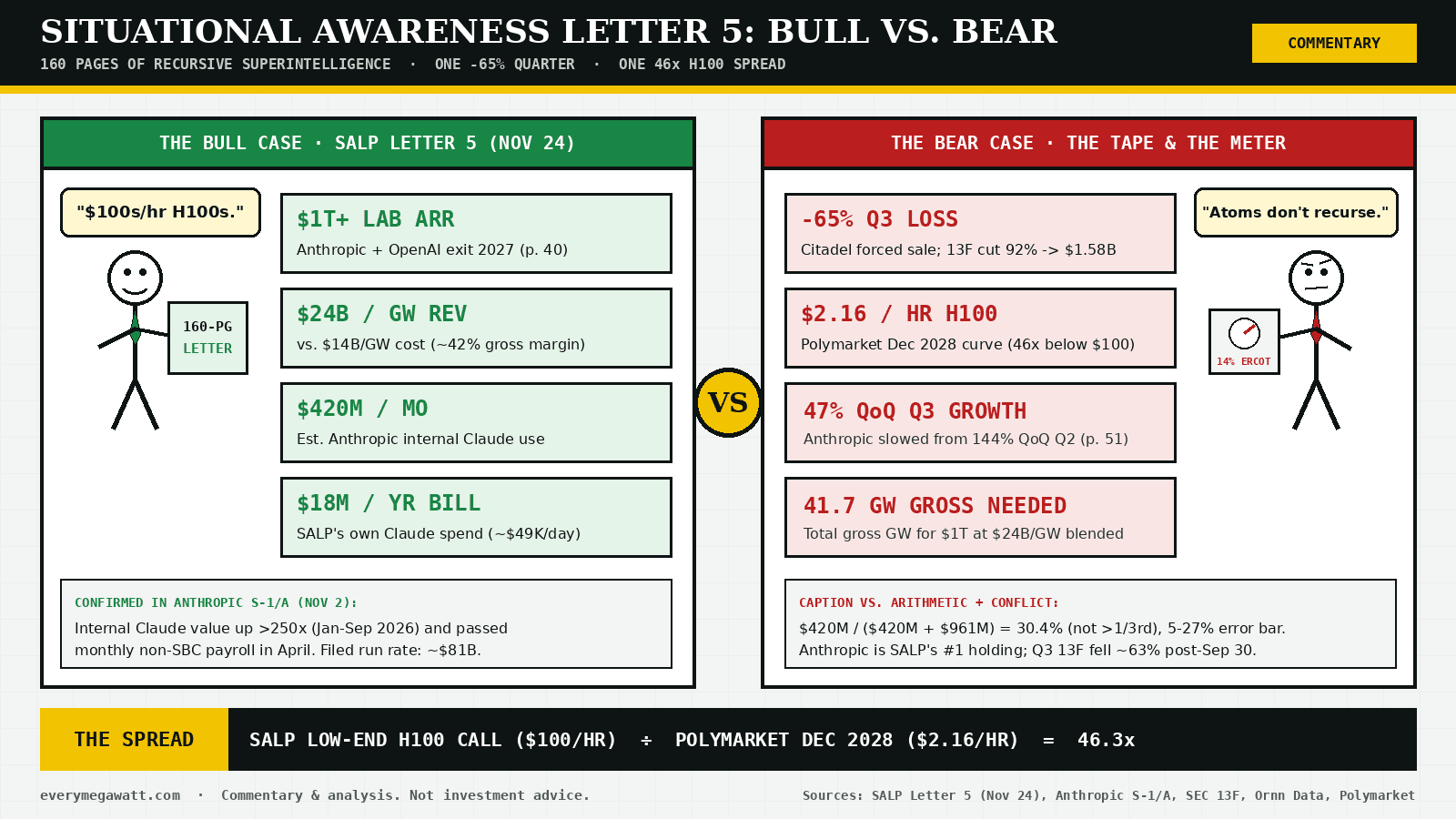
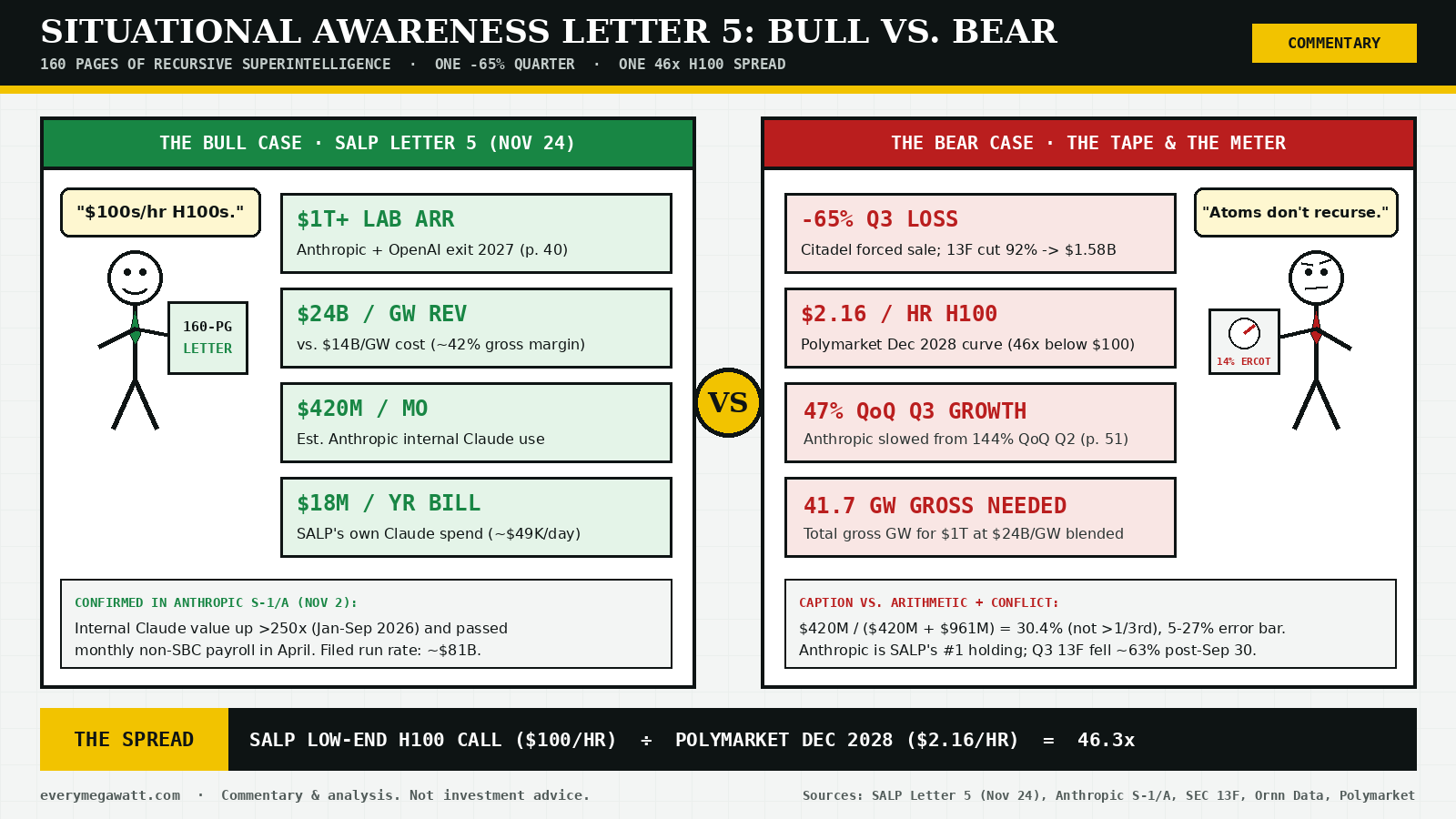
Leopold Aschenbrenner's hedge fund lost 65 percent after fees in the third quarter, survived a July margin call by selling most of its public stock book to Ken Griffin's Citadel, and answered back this week with a 167-page investor letter predicting $1 trillion in annual AI lab revenue within thirteen months.
By Saturday morning, screenshots from Situational Awareness LP's third-quarter letter ("Letter 5," dated November 24) had taken over AI Twitter. One chart claiming Anthropic itself consumes more than a third of all Claude usage worldwide cleared 370,000 views in hours and drew a public jab from Elon Musk over the fund's drawdown. Another screenshot showed the 30-person hedge fund running an $18 million annualized Claude bill of its own, roughly $49,000 a day.
Lost in the victory laps and dunk threads is a much cleaner way to read the document. Strip out the superintelligence prose, separate Anthropic's audited SEC disclosures from Situational Awareness's own estimates, and you are left with the sharpest Bull vs. Bear divide in AI infrastructure today.
First, Separate the Filings From the Forecast
Before taking a side, draw a hard line between what sits in public SEC filings and what is Situational Awareness's own pencil work.
| Claim | Source | Status |
|---|---|---|
| SALP Q3 2026 return: -65% net (+88.5% YTD through Sept) | SALP Letter 5 (via WSJ, Nov 25) | Disclosed by fund; Oct-Nov NAV omitted |
| SALP US 13F book fell 92% ($20.2B Q2 to $1.58B Q3) | SEC Form 13F-HR (CIK 0002045724, Nov 16) | Filed (excludes private stakes & shorts) |
| Anthropic internal Claude value up >250x (Jan to Sep 2026) | Anthropic Form S-1/A (Nov 2) | Filed (measured at list prices) |
| Internal Claude value passed monthly non-SBC payroll in April | Anthropic Form S-1/A (Nov 2) | Filed |
| Anthropic revenue run rate ~$81B on Oct 31; Q3 growth 47% QoQ | Anthropic S-1 / SALP Letter 5 (p. 40, 51) | Filed / cited in letter (~367% annualized) |
| Anthropic internal use = $420M/mo ("more than 1/3rd" of Claude) | SALP Letter 5 (p. 49) | Fund estimate (5%-27% Q3 compute range) |
| Anthropic gigawatt economics: $24B/yr revenue, $14B/yr cost | SALP Letter 5 | Fund estimate (~42% margin incl. training) |
| Anthropic + OpenAI exit 2027 above $1 trillion ARR | SALP Letter 5 (p. 40) | Fund forecast |
| H100 spot rentals rising from $5-$10/hr to "$100s/hour+" | SALP Letter 5 | Fund forecast (vs. $3.10 Ornn spot) |
One arithmetic catch jumped out immediately once readers checked the viral page-49 chart. Situational Awareness estimates Anthropic's Q3 compute spend at $3.29 billion a month: $1.91 billion for training and experiments, $961 million serving paying external customers, and $420 million for Anthropic's own internal Claude usage (up from $44.1 million a month in the first half). The caption rounds that to ">1/3rd of worldwide Claude usage." Divide $420 million by the $1,381 million total compute serving Claude, and you get 30.4 percent, just under a third, sitting inside an admitted 5 percent to 27 percent error bar on total compute. Anthropic's S-1/A does not disclose an internal compute share at all.
The Bull Case: Intensification Eats the Opex Budget
Give Situational Awareness credit where its thesis actually bites: the fund is not betting that your regional bank buys 50,000 $20-a-month chatbot seats. Its core argument on page 40 is blunt: "Diffusion is overrated while intensification is underrated."
In the letter's "opex ladder," the average Fortune 500 company still spends under 0.1 percent of operating expenses on AI, while frontier adopters like Stripe sit near 1 percent. At the far end of the curve sit two live experiments. First, Situational Awareness's own 30-person firm, which peaked at a $23 million annualized Claude run rate on October 30 and sat at $18 million on November 18, about $600,000 per employee per year. According to the letter, analysts stopped keeping Excel open next to Claude after Opus 5.5 arrived and shifted to running multiple parallel agents. Second, Anthropic itself, where published workforce data cited in the letter shows agents logging six hours for every human work hour company-wide and 19 hours per researcher hour, up from 0.2 in February.
That is how Aschenbrenner defends calling Wall Street's $120 billion to $200 billion end-2027 Anthropic run-rate range "the radical one." On his math, getting from Anthropic's ~$81 billion October run rate to $1 trillion combined across Anthropic and OpenAI requires heavy power users spending millions per department on autonomous "virtual departments," not slow enterprise seat rollouts.
On the infrastructure side, the letter ties that demand straight to the electric meter. It estimates Anthropic's revenue per kilowatt-hour quadrupled in 2026 to ~$2.70 blended and up to $11 on inference, while an Anthropic gigawatt earns roughly $24 billion a year against $14 billion in annual compute costs. It also points to SpaceXSI's May lease to Anthropic (~325,000 GPUs at $1.25 billion a month, ~$3.50/kWh) repricing up roughly 60 percent to ~$5.50/kWh in October on 90 days' notice, alongside short-term Nebius deals at $40 million to $50 million per megawatt-year. If a 1-kilowatt GPU begins producing output comparable to a specialist engineer, Situational Awareness argues, spot compute does not depreciate to $2 an hour. It reprices toward $100s an hour.
The Bear Case: Talking Your Own Book Against the Laws of Physics
The Bear desk does not need to argue AI is fake to poke four large holes in Letter 5. It just needs a calculator and this week's market tape.
1. The 46x H100 spread. Situational Awareness calls spot compute its biggest disagreement with the market. That is an understatement. On Ornn Data's November 25 settles, finalized H100 spot rent sits at $3.10 an hour, while Polymarket's new compute yield curve prices December 2028 H100 rent at $2.16 an hour. Even the low end of Situational Awareness's "$100s/hour+" call sits 32 times above today's spot settle and 46.3 times above the 2028 forward market. Meanwhile, CoreWeave five-year CDS hit 1,450 basis points on Thanksgiving and Anthropic broke below its $83 IPO floor two days after burning through its $12.2 billion greenshoe. Either bond traders and forward compute markets are asleep, or a hedge fund down 65 percent in Q3 is extrapolating its own $49,000-a-day Claude bill onto the S&P 500.
2. Self-consumption is not external cash. Anthropic's S-1/A confirms internal Claude usage valued at list prices grew more than 250x and beat non-SBC payroll. That is a real R&D signal. It is also zero dollars of external revenue. Counting internal tokens at retail list prices is like a restaurant eating a third of its own steaks and booking the menu price as proof that diners are lining up down the block. At the same time, Letter 5 itself acknowledges on page 51 that Anthropic's quarter-over-quarter revenue growth slowed from 132 percent QoQ in Q1 and 144 percent QoQ in Q2 to 47 percent QoQ in Q3 (still roughly 367 percent annualized). Calling a drop from 144 percent QoQ to 47 percent QoQ "lumpiness" is fine as a hypothesis, less convincing as a certainty.
3. The messenger's leverage and conflict. Anthropic is Situational Awareness's single largest conviction stake (leaving the fund roughly 70 percent public and 30 percent private post-IPO). Calling your biggest holding "shockingly cheap" while anchoring a $1.6 billion June round into GPU cloud Sharon AI (which SALP describes as a six-year, $4.9 billion Nvidia minimum floor around $1.30/kWh, though Sharon's June 12 SEC 8-K reads "up to $4.88 billion" with uptime termination clauses; shares are down from $68.73 in June to $17.28) is what hedge fund letters do. Investors still have to price the balance-sheet risk of the messenger: FourWeekMBA calculated that the nine US positions in SALP's September 30 13F fell roughly 63 percent in the eight weeks after quarter-end, from $1.58 billion to about $583 million, while Roundhill's memory ETF (DRAM) sits 57 percent off its June high.
4. Atoms do not recurse. The boldest section of Letter 5 (pages 112 to 117) warns that recursive self-improvement could strip incumbents like Nvidia, Broadcom, AMD, Microsoft, Apple, and Tesla of their moats (declaring Nvidia "cannot survive in its current form for more than a few years"), pointing to an unverified claim that OpenAI used AI to take its in-house Jalapeño chip from design to tapeout in nine months instead of 18 to 24. Even if AI writes perfect Verilog tomorrow, software cannot speed up TSMC fab lead times, transformer deliveries, or utility interconnection queues. In Texas, ERCOT's 474-gigawatt queue still sits at a 14.0 percent Permit-to-Plug Ratio. And if you apply Situational Awareness's own $24 billion-per-gigawatt blended estimate ($2.70/kWh across training, internal use, and inference) to its $1 trillion end-2027 ARR forecast, the two frontier labs would need roughly 41.7 gigawatts of total gross frontier compute online in thirteen months (roughly 10.4 gigawatts of pure external serving at SALP's $11/kWh peak, scaled up for training and internal compute).
The Bottom Line
Every megawatt will be monetized, eventually, and Letter 5 just put a hard number on what the maximum-conviction Bulls think a monetized gigawatt is worth: $24 billion a year in revenue and $100s an hour on an H100.
The market is currently offering the other side of that bet at $3.10 an hour today, $2.16 an hour in 2028, and 1,450 basis points on CoreWeave default insurance. That gap is too wide to settle with a Twitter thread, so we are saving the full physical stress test for a Research deep dive next week: how many actual substations, transformers, and CoWoS wafers it would take to clear $1 trillion in lab revenue by December 2027.
Every megawatt will be monetized.
Sources
- Wall Street Journal (Nov 25, 2026) on Situational Awareness LP Q3 2026 investor letter
- CellCog (Nov 28, 2026): cellcog.ai/blog/salp-letter-anthropic-clau…
- FourWeekMBA (Nov 28, 2026): fourweekmba.com/ai-aschenbrenner-anthropic…
- FourWeekMBA (Nov 28, 2026): fourweekmba.com/ai-aschenbrenner-sees-ai-l…
- FourWeekMBA (Nov 28, 2026): fourweekmba.com/ai-aschenbrenner-sees-h100…
- Anthropic PBC Form S-1/A (filed Nov 2, 2026)
- Situational Awareness LP Form 13F-HR (CIK 0002045724, filed Nov 16, 2026)
- Ornn Data & Polymarket H100 compute curve (Nov 25, 2026)