Sell Potato Chips, Buy AI Chips: Hedge Funds Just Paid 45x for Groceries to Escape 8x Silicon
Goldman Sachs says its Hedge Fund VIP basket just suffered one of its worst relative stretches in 20 years after running a 0.9 correlation to AI hardware. Managers fled to 10-year-high tilts in staples and cyclicals, leaving Walmart and Costco near 41x to 48x forward earnings while Nvidia and Micron trade in single digits.
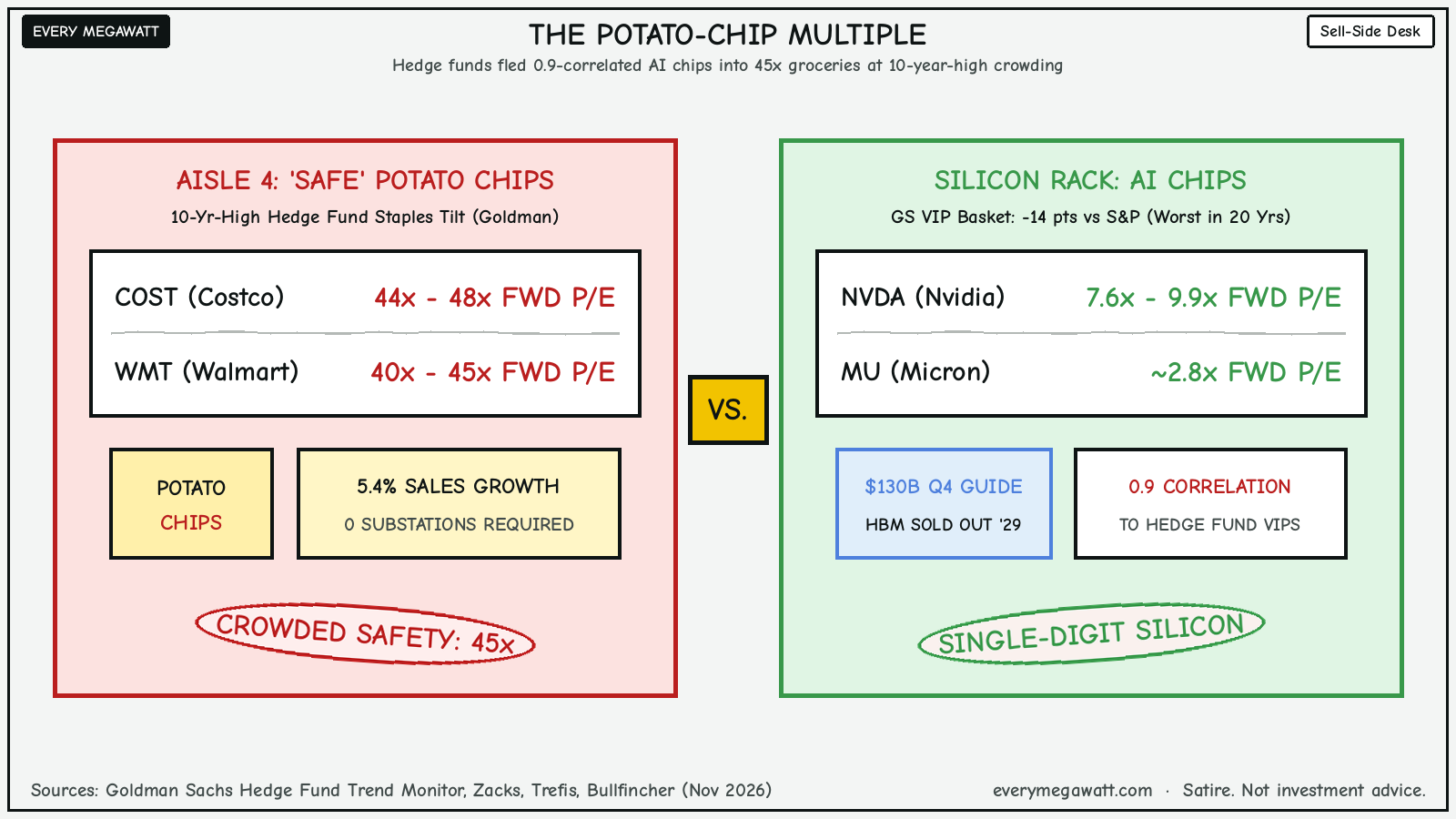
Every few years, Wall Street produces a pricing chart so upside down you have to read it twice. November 2026 just gave us a classic: big funds are paying 41 to 48 times earnings for grocery stores so they do not have to own AI chipmakers at single-digit prices.
The latest numbers come from Goldman Sachs's Hedge Fund Trend Monitor, written by Ben Snider and summarized Sunday by The Dark Side of the Boom. Goldman tracks the 50 stocks hedge funds own most heavily in a group called the Hedge Fund VIP basket. That basket just had one of its worst runs in 20 years.
Back in June, those 50 favorite stocks were beating the S&P 500 by 10 points. By November 19, they were 14 points behind. The VIP basket is down about 3 percent this year, while the S&P 500 is up 6 percent and the Russell 2000 is up 8 percent.
Why did hedge funds take a 24-point hit in five months? Because everyone piled into the exact same trade. Over the past three months, Goldman found the VIP basket moved almost lockstep (a 0.9 correlation) with AI hardware: chipmakers, memory, optical gear, and neoclouds. Software barely moved with it (0.1). When Nvidia posted its worst week since 2008, hedge funds all ran for the same exit at once.
The Stampede Into the Snack Aisle
When big funds get burned, they rarely sit quietly in cash. They cut their debt back to April selloff lows and pile into whatever feels safe.
Per Goldman's data, hedge funds entered the fourth quarter with 10-year-high bets on Consumer Staples, Utilities, Health Care, Financials, and Consumer Discretionary. Their newest favorites look like a weekend errand list: UnitedHealth, Union Pacific, Danaher, Toast, Home Depot, Allstate, and Merck.
Meanwhile, the price tag on America's favorite big-box stores has gone sky high. That gives the Sell-Side Desk a new metric: The Potato-Chip Multiple. It measures how much Wall Street will pay for bulk snacks and rotisserie chickens simply because neither one needs a high-voltage power line.
| Company / Ticker | Business Model | Forward P/E (Nov 2026) | Growth / Tape Context |
|---|---|---|---|
| Costco (`COST`) | Bulk groceries & $1.50 hot dogs | 44.4x to 47.8x | Trailing P/E near 51x; up ~29% in 2026 per Trefis |
| Walmart (`WMT`) | Supercenters & grocery rollbacks | 39.8x to 40.7x | Zacks consensus: 5.4% sales growth, 9.1% EPS growth |
| Nvidia (`NVDA`) | AI datacenter GPU monopoly | 7.6x to 9.9x | 13.48x trailing P/E after Nov 20 close; $130B Q4 revenue guide |
| Micron (`MU`) | High-bandwidth AI memory (HBM) | ~2.8x (Nov 21 fwd table) | ~8.0x trailing P/E; HBM & DRAM sold out through 2029 |
Look at those numbers. According to Zacks Investment Research, Walmart sells for more than 40 times next year's profits while growing sales around 5.4 percent and earnings around 9.1 percent. Costco sells for 44 to 48 times. Both are great companies. Neither one is growing profits at 60 percent, and neither one is sold out through 2029.
Yet in the exact same week Nvidia forecast $130 billion in quarterly sales and watched its stock sink anyway, `NVDA` fell to 13.48 times trailing earnings and single-digit next-year numbers. On X, finance Twitter summed up the entire argument over 2.8-times Micron in one meme.
Crowding Does Not Disappear
There are real risks in AI chips. As we covered yesterday in Elon Musk's cash-crunch warning and SpaceX's 8.3 percent GPU bond, companies have to pay for chips upfront and wait months for power and cooling before earning a dime. Government subpoenas do not help either.
Still, Goldman's data shows a funny catch: crowding never disappears when hedge funds switch sectors. It just moves down the street. Funds dumped single-digit chipmakers because everyone owned them, then piled into 10-year-high bets on grocery stores and old-school cyclicals at 45 times earnings. If growth slows or margins dip, the "safe" trade can jam up at the exit door just as fast as tech did on Friday.
On X, traders boiled the whole mess down to five words: sell potato chips, buy AI chips. Whether that pays off next quarter depends on credit markets and Washington, not jokes. Even so, paying 45 times earnings for a warehouse club to hide from an 8-times chipmaker is a bold bet that the world stops buying compute before it stops buying bulk tortilla chips.
Every megawatt will be monetized, even if hedge funds would currently rather pay 45 times earnings for a shopping cart in Aisle 4.
Satire. Not investment advice. Positioning and valuation figures from Goldman Sachs Global Investment Research summaries, Zacks, Trefis, and Bullfincher.
Sources
- - The Dark Side of the Boom (summary of Goldman Sachs Global Investment Research / Ben Snider Hedge Fund Trend Monitor: 20-year-worst VIP stretch, +10 pt to -14 pt swing, 0.9 AI correlation, 10-year-high staples/cyclical tilts), Nov 22, 2026
- thedarksideoftheboom.substack.com/p/bruise… - ZeroHedge: "Worst In 20 Years: Hedge Fund VIPs Crushed As Goldman Warns Cyclicals They Fled To Are Next," Nov 22, 2026
- zerohedge.com/markets/worst-20-years-hedge… - Zacks Investment Research: Walmart forward 12-month P/E (40.69x), Costco forward P/E (47.75x), Walmart consensus 5.4% sales / 9.1% EPS growth, Nov 16, 2026
- zacks.com/stock/news/3030096/walmart-expan… - Trefis: "Risky Nvidia Is Cheaper Than 'Safe' Walmart" (NVDA 16.8x CY / 9.9x NY vs WMT 44.5x / 39.8x and COST 48.8x / 44.4x), Nov 17, 2026
- trefis.com/stock/nvda/articles/625607/risk… - Bullfincher: Nvidia (`NVDA`) trailing P/E ratio (13.48x as of Nov 20, 2026)
- bullfincher.io/companies/nvidia-corporatio… - 24/7 Wall St.: Charlie Bilello trailing P/E comparison (COST 51x, WMT 46x, NVDA 23x pre-selloff), Nov 12, 2026
- 247wallst.com/investing/2026/11/12/the-lon… - 24/7 Wall St.: Micron (`MU`) valuation overview (~8.0x trailing P/E)
- 247wallst.com/companies/mu - Ehrmantraut Capital (`@EhrmantrautCap_`), `$MU` forward P/E bell-curve post, X, Nov 22, 2026
- x.com/ehrmantrautcap_/status/2124513595933…

