The AI Rack's Itinerary Is Now a Tariff Schedule
USTR's 16-economy excess-capacity probe covers Taiwan, South Korea, Malaysia, and Mexico, plus Japan, the EU, China, Vietnam, India, and Singapore. WSJ reports new tariffs could land as soon as this week, right after October capital-goods import prices posted their biggest jump since 1988.
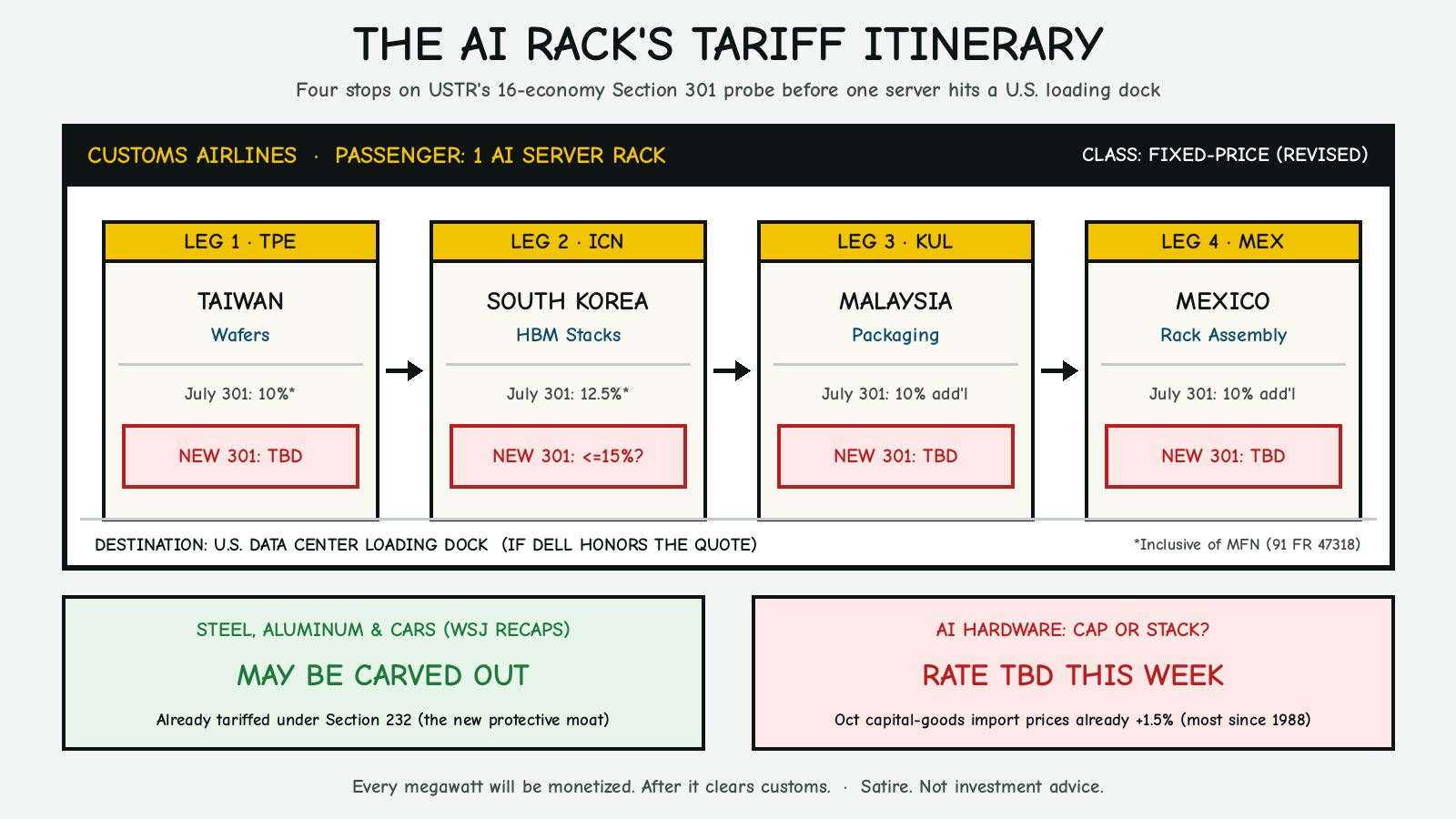
Wall Street likes to model AI infrastructure like software. U.S. customs processes it like a four-leg connecting flight.
Before the cash open on Tuesday, The Wall Street Journal reported (circulated across wire recaps from Investing.com, PANews, and Finansavisen) that the administration is preparing a fresh wave of Section 301 tariffs tied to its March excess-capacity investigation, with the Office of the U.S. Trade Representative possibly posting findings as soon as this week. No official proclamation has been published, and final rates, product scope, and timing remain undecided.
The immediate problem for AI hardware buyers is not the headline count. Some headlines call it "dozens of countries" because the European Union has 27 member states. The official March 11 USTR notice (91 FR 12886) names 16 economies: China, the European Union, Singapore, Switzerland, Norway, Indonesia, Malaysia, Cambodia, Thailand, South Korea, Vietnam, Taiwan, Bangladesh, Mexico, Japan, and India.
Read that list out loud and it stops sounding like trade policy and starts sounding like the bill of materials for one AI server rack. Taiwan, South Korea, Malaysia, and Mexico all sit on the 16-economy list, alongside Japan, the EU, China, Vietnam, India, and Singapore. As traders on X quickly pointed out before the open, a single rack can touch wafers in Taiwan, high-bandwidth memory in South Korea, packaging in Malaysia, and server assembly in Mexico before it ever reaches a U.S. data-center loading dock. Every stop on the itinerary is currently sitting in the investigation folder with a rate marked TBD.
The Surcharge on the Surcharge
The new layer would not arrive on a blank invoice. Under USTR's existing July 24 forced-labor Section 301 action (91 FR 47318 and the USTR July fact sheet), most of these economies already carry an active duty.
| Economy (Official 16-Economy Probe) | Official July 2026 Section 301 Layer | Reported New Layer (WSJ Recaps, Unofficial) | Conditional Cap Headroom (If 15% Is a Cap, Not a Stack) |
|---|---|---|---|
| European Union, Taiwan | 10% inclusive of MFN | EU: 15% or less; Taiwan: rate undecided | 5.0 percentage points (if capped at 15%) |
| Japan, South Korea | 12.5% inclusive of MFN | 15% or less (per earlier deal frameworks) | 2.5 percentage points (if capped at 15%) |
| Malaysia, Mexico | 10% additional duty | Rate undecided | Undecided |
| India | 10% additional duty | Possibly higher than 15% | No published cap |
| China, Vietnam | 12.5% additional duty | Possibly higher than 15% | No published cap |
That table captures the exact headache hitting sell-side models before the open: nobody can tell whether 15 percent is a ceiling or a second stamp. Several recaps of the WSJ report say the new excess-capacity duties would likely stack on top of the July 10 percent to 12.5 percent layer, while the same coverage says the EU, Japan, and South Korea could face 15 percent or less in line with prior trade deals. Those two statements do not fit neatly on the same calculator, so until USTR prints actual tariff text, any all-in number floating around the timeline is guesswork.
What is not guesswork is what was already happening to hardware invoices before Tuesday morning. As we noted on Sunday in our Dell and XTX breakdown, official Bureau of Labor Statistics data showed U.S. capital-goods import prices jumped 1.5 percent in October, the largest monthly increase since the series began in December 1988, while the computer, peripheral, and semiconductor import index (`IR213`) jumped 3.6 percent in a single month (from 59.0 to 61.1). Server vendors were already walking back signed "fixed-price" contracts to ask for 25 percent to 45 percent more on memory surcharges.
Dell reports third-quarter results after the close today (4:30 PM ET webcast), followed by HP Inc. at 5:00 PM ET. Quoting a "price certainty" fee gets considerably harder when customs has not finished typing the next line item.
Already Being Tariffed Is Now a Moat
The sharpest deadpan twist sits in the carve-outs. Per the WSJ recaps, steel, aluminum, and automobiles may be excluded from the new wave because they already carry national-security duties under Section 232 (just as USTR's July action explicitly exempted Section 232 articles).
In 2026 trade policy, the safest way to avoid a surprise tariff is to already have one. Old-economy metal gets a neat checked box marked exempt. The silicon, memory, packaging, and server racks underwriting a multi-hundred-billion-dollar AI capex buildout sit in the lane marked "Check back this week."
Every megawatt will be monetized. After it clears customs.
Sources
- - Official 16-economy investigation: USTR press release (Mar 11, 2026)
- Federal Register 91 FR 12886 (Mar 17, 2026). - Official July Section 301 rates and Section 232 exemption: Federal Register 91 FR 47318 (Jul 28, 2026)
- USTR July fact sheet. - WSJ tariff wave reporting and secondary recaps (Nov 24, 2026): Investing.com
- PANews
- Finansavisen. - Import-price baseline and server surcharges: Every Megawatt (Nov 22, 2026) (citing BLS USDL-26-1711 and FRED series IR213).


