XTX Paid Dell $5 Million for 'Price Certainty.' Then Dell Asked for Another $70 Million.
Dell, HPE, Lenovo, and Supermicro are asking AI server buyers for 25 to 45 percent more months after contracts are signed, per the Financial Times. Official chip import prices just posted their sharpest monthly jump since 1988.
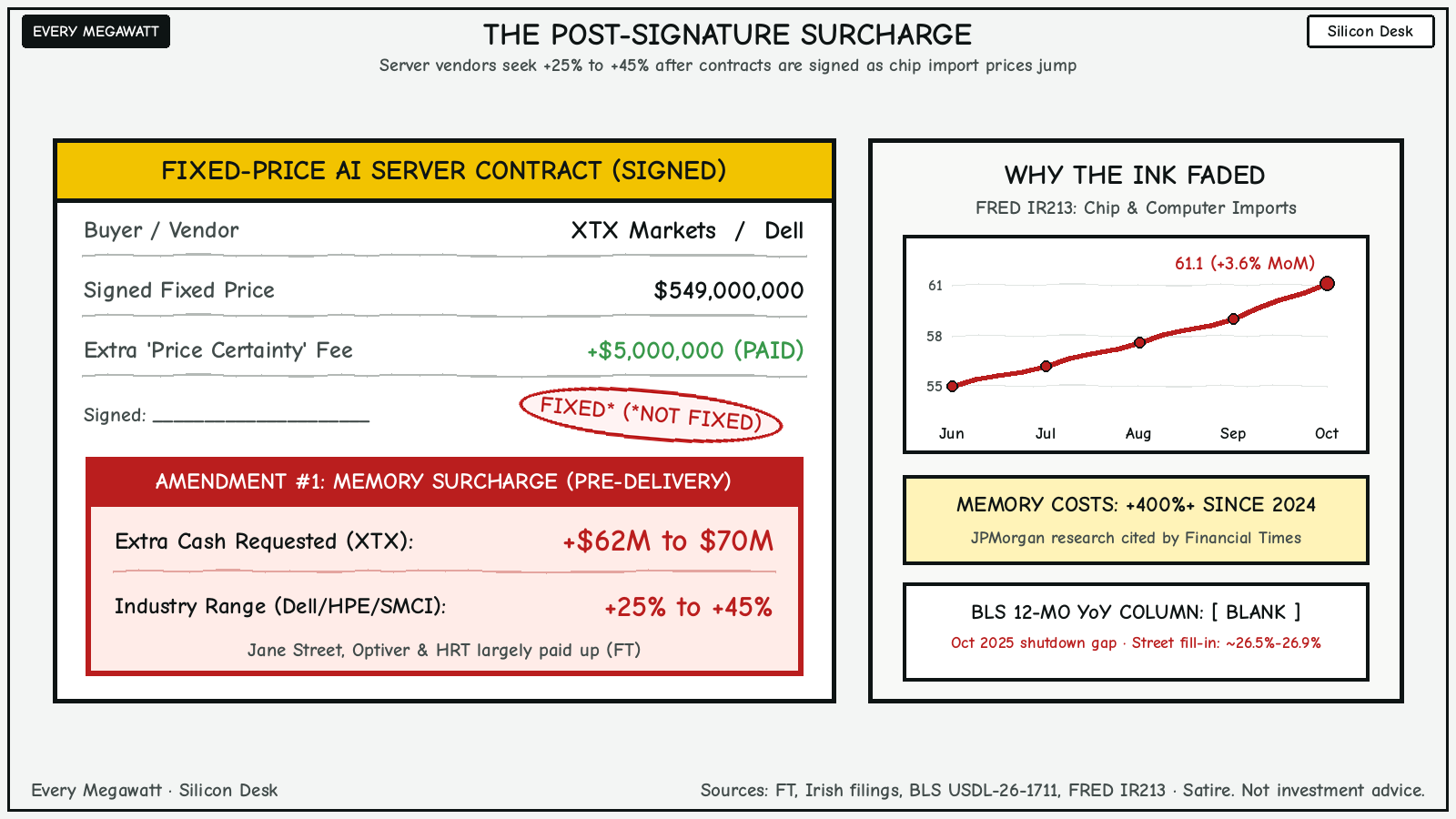
In the AI hardware market, a signed contract is now an opening bid.
Overnight, the Financial Times reported (as relayed by The Times of India and Superpower Daily) that Dell, HPE, Lenovo, and Supermicro are going back to AI server customers months after deals were signed and asking for 25 to 45 percent more money before delivery. The culprit is memory. JPMorgan research cited by the FT puts memory costs more than 400 percent higher than at the start of 2024, pushing GPU-server prices up 20 to 30 percent and tripling CPU-node prices.
The purest receipt sits in Irish court filings cited by the FT. Quantitative trading giant XTX Markets sued Dell in June over a fixed-price server deal worth $549 million. XTX had paid an extra $5 million specifically to lock in price certainty. Dell still came back asking for at least another $62 million to $70 million, saying it could not absorb the memory spike. That is the same vendor whose chairman recently posted that H100 rentals were up 58 percent and replied to himself to clarify it was not investment advice. Apparently, fixed-price contracts are not pricing advice either.
Other quant sharks did not even bother fighting. Per the FT, Jane Street, Optiver, and Hudson River Trading are all getting hit with higher bills as they build out data centers, and most trading firms have simply paid up because they cannot wait for racks. When the sharpest market makers on Earth eat a post-signature markup without blinking, pricing power has officially migrated from the AI model to the memory packing slip.
The macro tape backs up the sticker shock. A widely shared Sunday chart from The Kobeissi Letter flagged a 26.5 percent year-over-year surge in U.S. import prices for computers, peripherals, and semiconductors. One technical footnote makes the story even better: in its November 17 release (USDL-26-1711), the Bureau of Labor Statistics left the official 12-month column completely blank because the October 2025 federal shutdown prevented data collection. Analysts filled in the missing line themselves. Wolf Street interpolated the missing base at roughly 26.9 percent, before tariffs.
What the government could print is plenty loud on its own. Per FRED series IR213, the import-price index for computers, peripherals, and semiconductors jumped 3.6 percent in a single month, from 59.0 in September to 61.1 in October. Overall capital-goods import prices rose 1.5 percent in October, the biggest monthly leap since the series began in December 1988.
| Line Item | Original Deal / Baseline | Revised Reality | Source |
|---|---|---|---|
| XTX Markets / Dell contract | $549M + $5M certainty fee | +$62M to $70M sought | FT / Irish filings |
| Server vendor re-pricing | Signed AI server contracts | +25% to +45% pre-delivery | Financial Times |
| Memory cost baseline | Early 2024 | +400%+ higher | JPMorgan via FT |
| Chip import index (IR213) | 59.0 (Sep 2026) | 61.1 (Oct 2026, +3.6% MoM) | BLS / FRED |
| Official 12-month YoY column | Oct 2025 to Oct 2026 | Blank (Street fill-in: ~26.5% to 26.9%) | BLS / Kobeissi / Wolf St. |
Wall Street spent all year modeling gigawatts, power queues, and GPU shipments out to 2030. Nobody modeled the moment the server vendor walks back into the room with a revised invoice and a straight face. Every megawatt will be monetized, and if memory keeps climbing, you may have to pay for the same megawatt twice.


