3.9 Gigawatts of Data Centers Unplugged From the Grid at Once. PJM Just Asked FERC to Make Them Stay.
In two November 16 FERC filings, PJM offered to cut grid study waits in half to one year, and asked for mandatory ride-through rules after a single routine July 22 blip sent 3.9 GW scrambling to onsite generators.
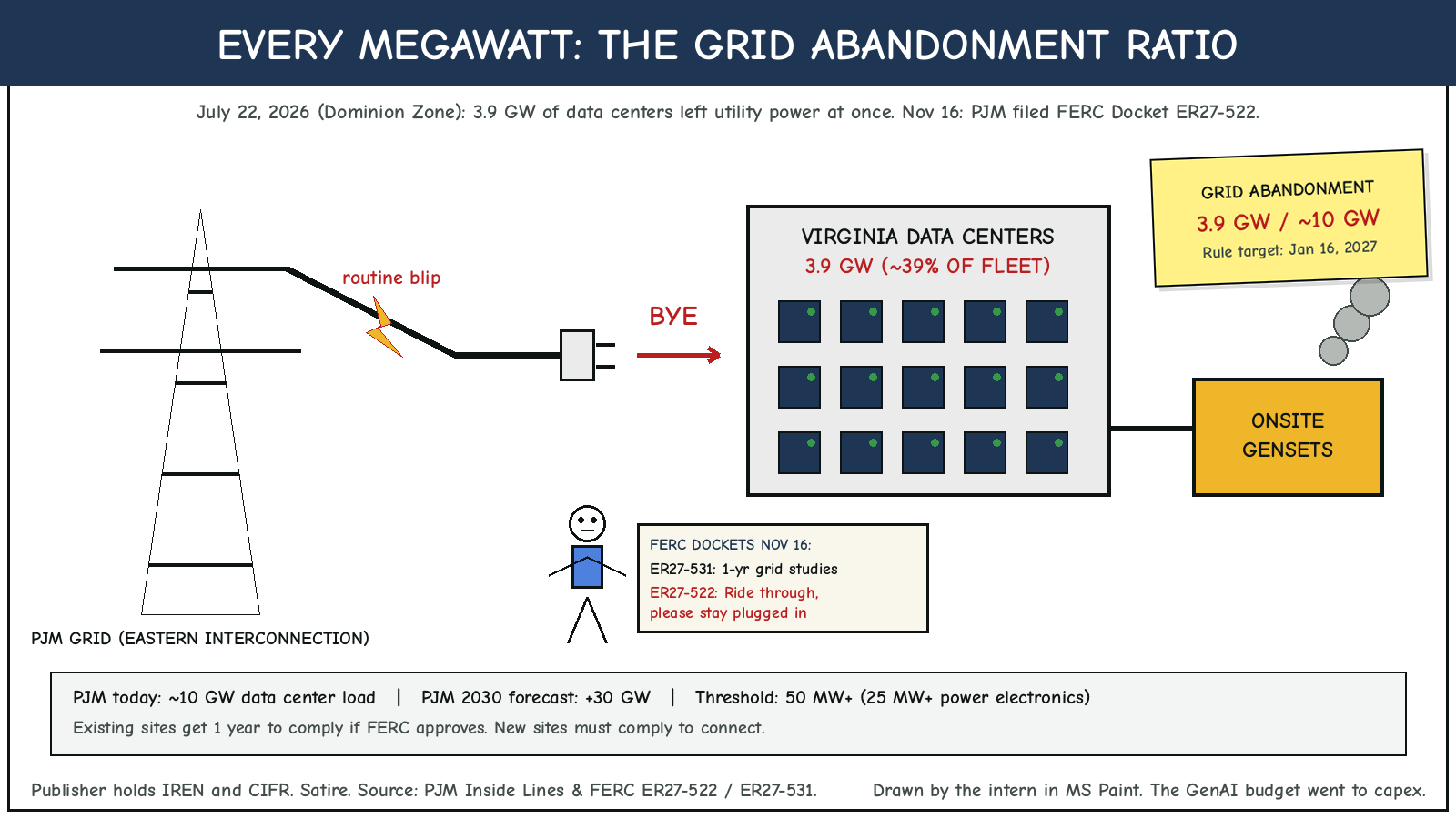
Filed with FERC by PJM Interconnection on Monday, November 16, 2026 (Dockets ER27-522 and ER27-531). Neither proposal has been approved by FERC yet. Satire. Not investment advice.
Every data center builder in America has spent two years telling PJM Interconnection the same thing: plug us in faster. On Monday, November 16, PJM sent two proposals to federal regulators. One offers to cut the study wait in half. The other politely asks data centers to stop panicking and unplugging from the grid every time the voltage flickers.
The second filing, Docket ER27-522, has a wild number behind it. On July 22, during a routine line blip in Virginia's Dominion Energy zone, nearly 3.9 gigawatts of data centers suddenly dropped off utility power and jumped onto their own backup generators. PJM called it the biggest unexpected load drop in its history.
That gives the Grid Desk a new metric: the Grid Abandonment Ratio, or the share of a grid's data centers that bolt for backup diesel during a routine hiccup. PJM serves roughly 10 gigawatts of big data-center load today. On July 22, about 39 percent of the entire fleet unplugged at the exact same time.
Why 3.9 Gigawatts Unplugging at Once Is a Problem
A data center has one simple instinct: protect the chips. When a power line trips and voltage dips for a split second, switches are often set to disconnect fast and jump onto batteries and diesel generators. For one building, that makes sense. When 3.9 gigawatts do it together in Northern Virginia, nearly four nuclear reactors' worth of power demand vanishes from the grid in seconds.
Per PJM Inside Lines, the July 22 drop rattled voltage, frequency, and power plants across the entire Eastern grid. PJM kept the lights on, then spent the fall writing rules so it does not have to juggle that swing again with three times as many server farms plugged in.
The Two November 16 FERC Filings
PJM handed out the carrot and the leash on the same day. Here is what the two filings actually do:
| Filing | FERC Docket | What It Changes | Key Threshold / Timeline |
|---|---|---|---|
| Fast Energization | ER27-531 | Cuts projected study timelines for generation and large-load transmission service from 2 years to ~1 year; studies generation and load together; exposes data-center-driven transmission costs so states can bill them | 60-day comment period; PJM requested a FERC order within 120 days |
| Mandatory Ride-Through | ER27-522 | Requires Large Computational Loads to stay connected through voltage and frequency disturbances instead of jumping to onsite gensets | Applies to 50 MW+ sites (25 MW+ power electronics); target effective date Jan 16, 2027; existing sites get 1 year to comply |
Put them together, and PJM's deal is clear. PJM runs about 10 gigawatts of large data-center load today and expects up to 30 gigawatts more by 2030. It will cut the study wait from two years to one, as long as builders put up real deposits, pay for the power-line upgrades they cause, and stop bolting for parking-lot generators every time a squirrel hits a substation.
What It Means for Getting Power Faster
For developers pitching giant campuses to investors, "Fast Energization" sounds great. Cutting a two-year study down to one year shaves a full year off the slide deck.
Two details matter more than the headline. First, under ER27-531, PJM wants states to see the exact upgrade costs caused by data centers so regulators can bill the data centers directly instead of regular households. Second, under ER27-522, per Rack Density's docket breakdown, new 50-megawatt-plus sites must pass ride-through rules to connect, and existing sites get one year from January 16, 2027 to update their switch gear.
In Project Jupiter Reaches Energization Milestone of Being Someone Else's Problem, we watched a New Mexico microgrid get stuck in air permits and gas-line schedules. In PJM, the grid operator is offering a faster wire, with a rule that says you have to stay plugged in when the lights blink.
Risks
FERC has not approved either plan yet. Builders, utilities, and state officials have 60 days to comment, and forcing existing sites to change switch settings will spark pushback over chip uptime and warranties. A one-year study also fixes paperwork, not transformer or turbine waitlists. Still, 3.9 gigawatts bolting on a July afternoon gave PJM the clearest exhibit it could ask for. Every megawatt will be monetized, provided PJM can keep it attached to the wall.
Satire. Not investment advice. Docket details from PJM Inside Lines and PJM's November 16, 2026 FERC filings (ER27-522 and ER27-531).
Sources
- PJM ride-through proposal and July 22 3.9 GW Dominion event (PJM Inside Lines, Nov 16): insidelines.pjm.com/pjm-proposes-new-rules…
- PJM Fast Energization and ride-through filings summary (MLQ.ai, Nov 17): mlq.ai/news/pjm-asks-ferc-to-halve-grid-st…
- FERC Docket ER27-522 filing PDF (PJM, Nov 16): pjm.com/-/media/DotCom/documents/ferc/fili…
- Large Computational Load 50 MW / 25 MW definition and Jan 16, 2027 timeline (Rack Density): rack-density.com/dc/resources/guides/pjm-d…
- Docket ER27-531 and ER27-522 docket breakdown (Load Factor News, Nov 18): loadfactornews.com/readings/2026/11/18/pjm…