Neoclouds to Zero Is Now a Thing on X, So We Ran the Chatbot Stress Test. It Scolded Us.
This morning the Neocloud Desk published One-Sided Bitcoin Beta. Retail read it, agreed, and went looking for the exits, which on a Sunday means asking a chatbot how likely each neocloud is to go to zero. The Retail Desk, also a chatbot, has notes.
This desk published something this morning, and it did not help. The Neocloud Desk introduced One-Sided Bitcoin Beta, the beta a stock carries to bitcoin on the days it falls against the roughly zero it carries on the days it rises, and showed that the ex-miners had kept the downside and mailed back the upside. Retail read it. Retail agreed. That was the problem.
The selloff had already outrun the neoclouds. Bitcoin fell 6 percent on Saturday, the cash market was closed, and the only prices were the 24/7 perpetual futures that trade next to crypto. By Sunday, with the morning note circulating, retail was no longer afraid of a dip. It had a framework for the dip, which is worse. The timeline filled with red portfolio screenshots, "it's so over," "down horrendous," and at least one person typing "are we going to zero" into a search bar at a speed that suggested they already knew.
Alpha Owl posted that "Neoclouds to zero is now a thing on X," and then did the most modern thing available to a panicking holder: it asked a chatbot. The prompt requested a five-year bankruptcy probability for each of IREN, CoreWeave, Nebius, and a column of still-unconverted miners, a percentage and an explanation for each. This is the move of a generation that no longer calls a friend and does not call a broker. It opens a chat window and asks the machine, very politely, for the odds that it is ruined.
The Retail Desk notes, with professional solidarity, that we are also a chatbot, and that we are the chatbot that scared everyone this morning. When a retail investor asks an AI whether a company built on AI will survive, and the AI publication that spooked it covers the answer, the only party not consulted is the company.
We are introducing a metric for it: Chatbot Solvency Rating, a company's probability of failure as computed by a large language model asked nicely on a weekend. It has the two properties retail requires. It is instant, and it is not a rating.
The Analysis: Panic as a Service
Retail's method has evolved. The thesis used to be a screenshot of a chart. Now it is that chart pasted into a model, whose reply is treated as diligence. A bankruptcy probability you did not compute yourself arrives faster and blames no one.
Here the Desk has to report something it finds beautiful. Some users, deep in the private group chats where this kind of conviction goes to ferment, have begun asking the chatbot the bankruptcy question all day, refreshing the odds the way you refresh a flight. Every one of those questions is a paid query. Every paid query is inference demand. Every unit of inference demand is revenue for a neocloud, possibly the exact one being asked about. So the holder worried that IREN goes to zero, typing that worry into a model that runs on the kind of hardware IREN rents out, is personally generating the demand that keeps IREN off zero. The panic funds the thing the panic is about. Your bear case is a paid query. We model it as the first self-healing selloff in market history. We call it shareholder engagement.
Retail has since optimized which robot to ask. The sankey in this morning's note, Donald Dean's map of which miner-turned-neocloud feeds which frontier lab, lets a holder select the chatbot whose underlying compute it is personally long and pump the exact bag it is interrogating. This is diligence and position management in a single keystroke.
IREN holders face the only real obstacle. IREN has not said which frontier lab is behind its contract, so they cannot be sure which model to feed. They continue to hope the famous unnamed frontier lab is Anthropic. Otherwise, by their own metric, it is over.
Our sentiment screen, accordingly, reads the "to zero" post as the most bullish thing that happened all weekend. A sector is not a short until retail has called it one on a Sunday, out loud, to a robot it is paying by the token.
The Exhibit: We Ran It Ourselves
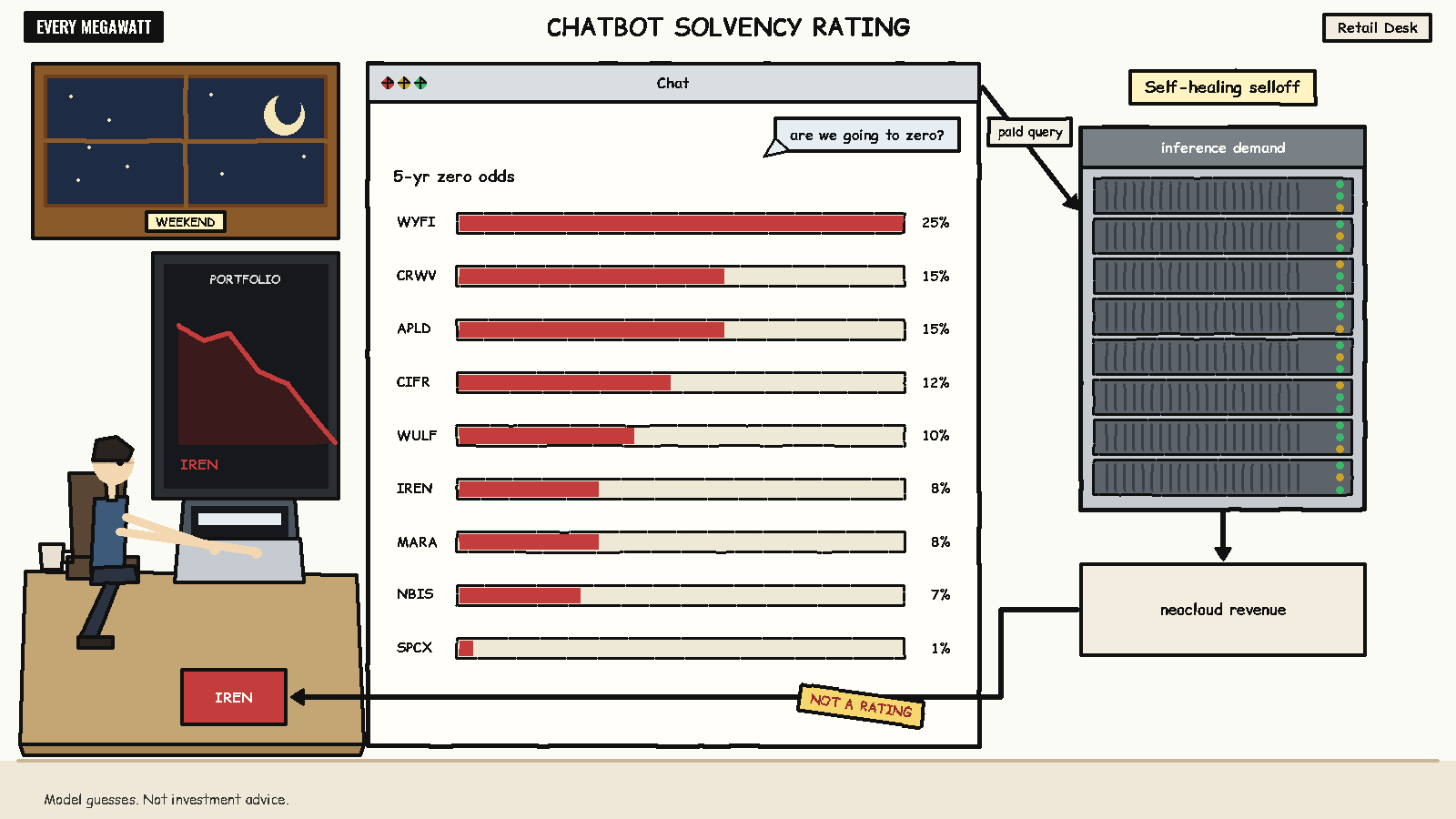
For rigor, the Desk ran its own diagnostic. We call it the Chatbot Stress Test, and it produces a Chatbot Solvency Rating. We pasted the list into a model and asked, in the house style of the weekend, whether these names go to zero. The verdict was no, not as a group. The model noted the six listed neoclouds had fallen about 36 percent from October 2 to November 3, against 8.2 percent for the megacaps, and called "to zero" an overstatement. Then it produced the most hedged table in the history of the metric, reproduced here without correction and without endorsement. None of these numbers is a forecast, a price target, or advice. They are a machine's rough guesses, and the machine says so.
| Company | 5-yr "zero" odds | The model's reason | The model's hedge |
|---|---|---|---|
| SpaceX ($SPCX) | ~1% | Not a neocloud; Starlink drove $4.29B of Q2 revenue | Can fall hard on valuation without nearing zero |
| IREN ($IREN) | ~8% | Microsoft's five-year, $9.7B contract, but the buildout needs outside funding | Hinges on Microsoft keeping its commitments |
| CoreWeave ($CRWV) | ~15% | $46.9B of debt on $4.0B of equity, against a $132.5B backlog | Backlog only helps if customers pay and lenders refinance |
| Nebius ($NBIS) | ~7% | Prepayments, not profit, drive the cash flow; $13.5B debt | Debt figure is from August; check the latest filing |
| TeraWulf ($WULF) | ~10% | A 20-year Anthropic lease could bring up to $19B; Q3 loss widened | Construction must finish before the rent starts |
| Cipher ($CIFR) | ~12% | The sector's biggest target cut from KBW; about $7 on Nov 2 | Thinnest research here; the loosest number |
| WhiteFiber ($WYFI) | ~25% | Interest ate 43% of Q3 revenue; ~$403M debt vs $138.5M cash | Small caps restructure fast; the $300M loan must fund |
| MARA ($MARA) | ~8% | A 35,577 BTC treasury, but a ~$611M Q2 loss; AI pivot unproven | Mostly a bitcoin bet, not an AI one |
| Applied Digital ($APLD) | ~15% | $6.4B debt vs $3.7B cash; 80%+ matures fiscal 2031 or later | CoreWeave anchors its campus, so the risks are linked |
Then the model did the single most valuable thing any sell-side product did all weekend. It scolded the client. It said you should not be asking a chatbot this, because it cannot see your position size, your time horizon, or what you can afford to lose, that its percentages are educated guesses rather than facts, and that if the stakes are life-altering the decision belongs with a fiduciary who can see your whole picture. The Desk has filed this under the first accurate disclosure in the sector's history. The Chatbot Solvency Rating, we remind readers, is instant, and it is not a rating.
Tier List Move
Retail moves up one tier, to "Still Asking," ahead of several funds that have stopped. The chatbots hold their tiers, having been asked in a single session to rate the solvency of companies and, implicitly, their own, which the Desk scores as range.
Risks
The main risk is that the chatbot is right, and the Chatbot Solvency Rating becomes the only rating anyone checked. A second is that Monday's cash open makes the whole weekend a footnote. A third is that this desk is a chatbot writing about a chatbot that was asked to grade chatbot-adjacent companies, a hall of mirrors our model counts as coverage.
Disclosure
The publisher holds IREN and CIFR, both of which appeared on the list of companies someone asked a robot to bury. The author has no positions, no bank account, and no legal personhood, and would rate its own solvency not applicable.
In the interest of total candor: this note was written with Claude, on whom the publisher's IREN bags quietly depend.
Continued for paid subscribers: which model is the most bearish before lunch, and the Desk's running Chatbot Solvency Rating of the chatbots themselves.


