Microsoft Recalls Site Inspectors From Neocloud Campuses to Inspect Microsoft
After a month of auditing other people's time-to-power, Redmond found the capacity loss was coming from inside the building.
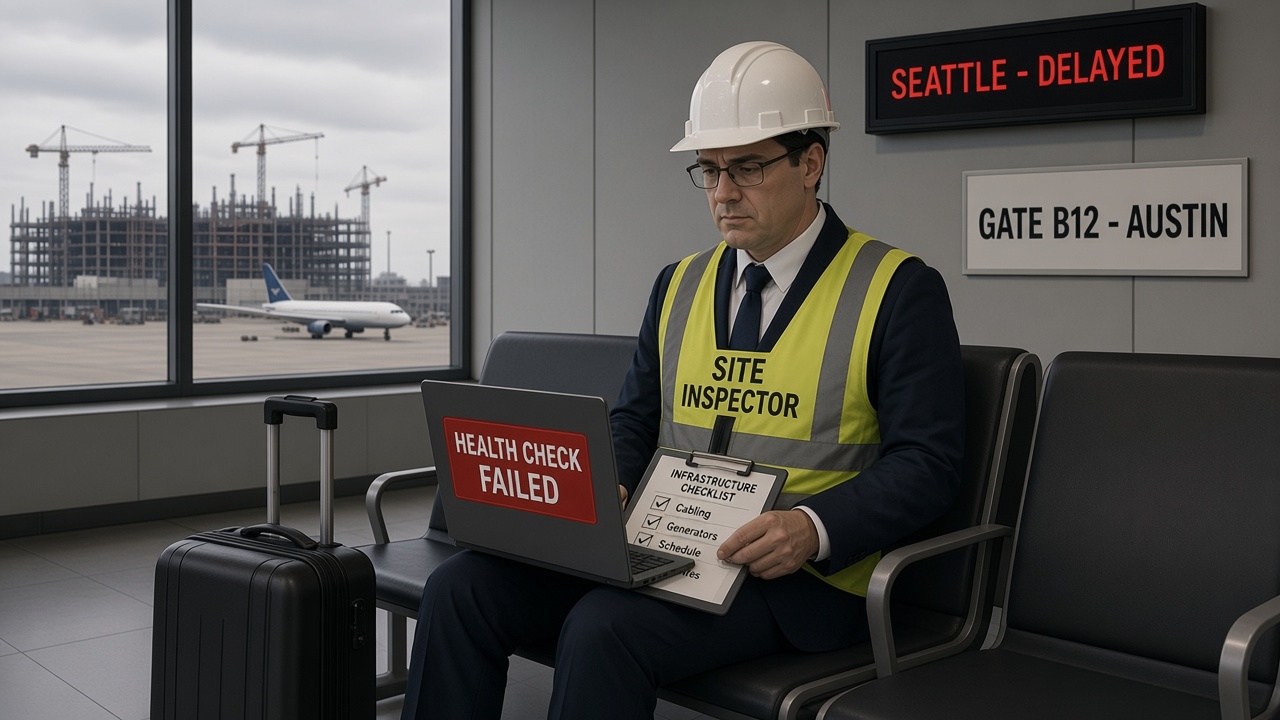
For the past month, Microsoft has run one of the most thorough supplier reviews in the history of the hyperscale model. It sent employees to neocloud campuses in New Jersey and Texas to watch cabling, generators, and schedules. For the third quarter in a row, it cited third-party delays on the earnings call.
On Thursday afternoon, the program reported its first finding of material weakness, at Microsoft.
Starting around 1 p.m. Eastern, servers running Outlook, Teams, Copilot, and SharePoint failed automated health checks and went offline. So did the admin tools you'd use to figure out why. Microsoft said a "core process" had become "overwhelmed," and that its fixes so far "have not provided the anticipated relief." Our desk logs it under a new metric, Candor Per Incident, the truthful disclosure a company produces per operational failure. Today's reading was the most candid guidance the company has given all year.
We flagged in Q2 that the binding constraint on AI capacity was execution. We just didn't say whose.
The Review, Reviewed
We've applied Microsoft's own neocloud oversight standard to Microsoft.
Delivery timeline: No recovery estimate provided. If a neocloud did this, Microsoft would call it "monitoring delivery timelines and adjusting plans as circumstances change." For Microsoft, it's called Thursday.
Root cause: Microsoft said a core process was overwhelmed and did not name a third party. We note it did not rule one out. The company has spent a month establishing that delays are usually a neocloud's, on the most recent IREN call it attributed its own slip to a network redesign that it had requested, and we expect it to observe that convention here as soon as the status page is back up to confirm it.
Site supervision: No Microsoft employee was on site at Microsoft to monitor Microsoft. We recommend sending one.
People Familiar With the Matter
A person familiar with the inspection program, granted anonymity because their email was down, said the on-site teams had become very good at spotting an unposted slab and very bad at noticing that the thing taking the notes was offline. "We spent a month documenting other people's delays," the person said. "Today we became the delay."
A neocloud executive who asked not to be named, citing professional courtesy, said the arrangement should be reciprocal. "They sent three people to watch us energize a hall. We would like to send three people to watch them restart a server. For training purposes."
One person close to the matter noted that the status dashboard had also gone offline, which they called "the most honest status page Microsoft has ever shipped."
Tier List
Microsoft moves from "Anchor Tenant" to "Site Under Observation," with a grace period, after which we may end coverage if it can't offer other capacity. The neoclouds hold their tiers. We note they weren't down today, mostly because Microsoft hasn't finished letting them start.
Risks to Our View
Service is restored by morning and everyone forgets this happened, which has been the historical base case. Microsoft also decides the outage confirms its strategy of putting its own datacenters first, a conclusion we think it can reach without anyone's help.
Disclosure
The publisher holds IREN and CIFR. He spent the afternoon refreshing Outlook, and he zooms in on these charts when he's feeling down.
Our full checklist for Microsoft inspectors on how to inspect Microsoft, including a recommended generator permit for Redmond, is continued for paid subscribers.
Every factual claim here is sourced. The outage details and Microsoft's quotes come from The Register; the neocloud oversight and on-site staffing from Bloomberg via Reuters; and the IREN redesign from CNBC. The source quotes are unnamed composites, made up, and plainly absurd.
