The Ghost Balance Sheet: How Big Tech Parked $1.89 Trillion of AI Commitments in the Footnotes
Four regulators read the same SEC footnotes in ten days and put AI off-balance-sheet exposure at $3 trillion to $4 trillion. Here is the plain-English guide to the four legal accounting rules keeping $1.89 trillion of leases and guarantees off the debt line.
By Nadia Ellison · Capital Markets Desk · November 27, 2026Share on X
Headline Metric · Shadow Leverage Multiplier (SLM)Updated November 27, 2026
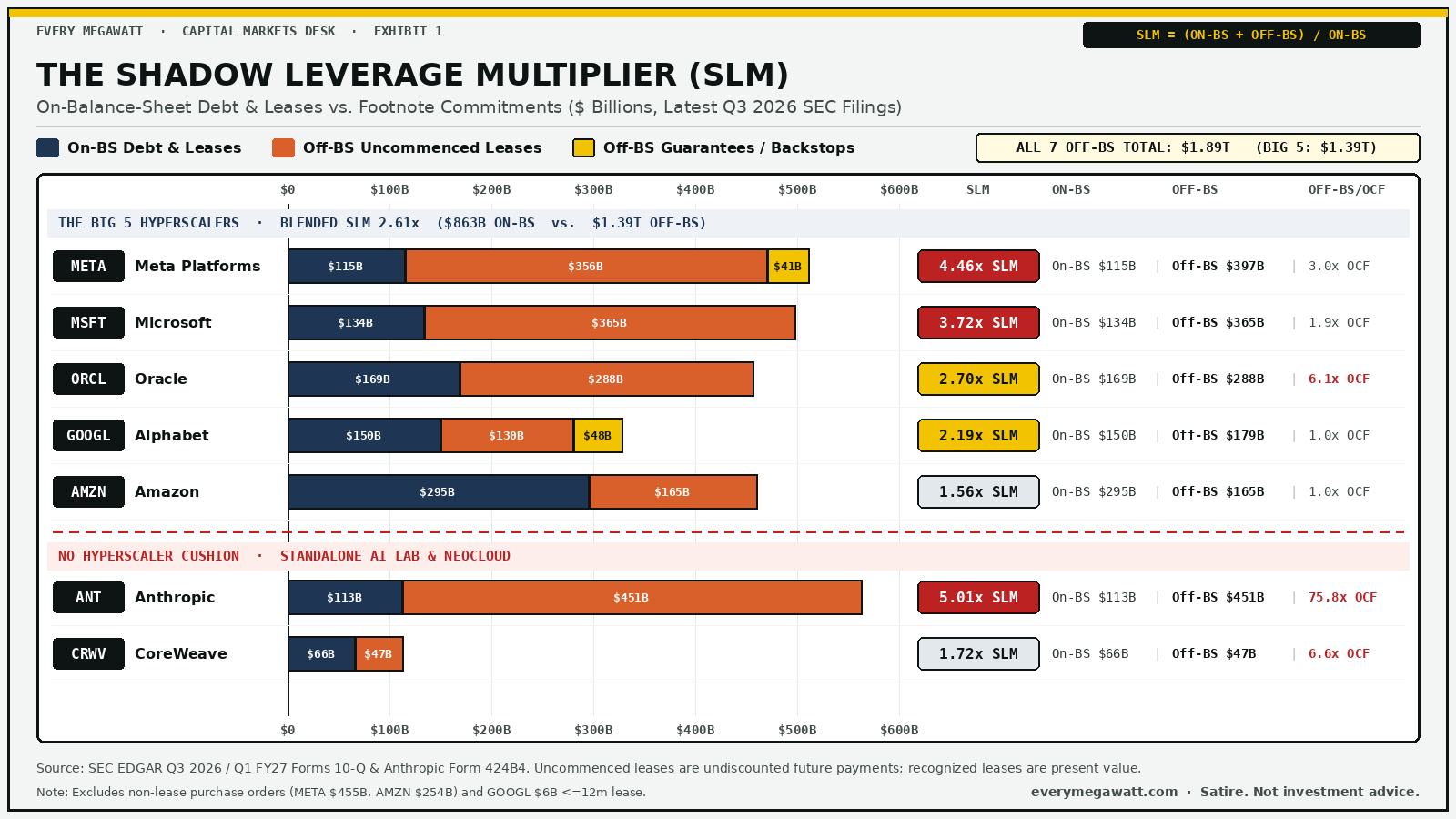
Total on-balance-sheet debt and recognized leases plus off-balance-sheet uncommenced leases and disclosed maximum credit/residual-value guarantees, divided by on-balance-sheet debt and recognized leases. 1.00x means all obligations sit on the balance sheet; Big 5 hyperscaler Q3 2026 blended SLM is 2.61x (led by Meta at 4.46x and Anthropic at 5.01x).
If you want to know how nervous credit regulators are about AI right now, count how many of them read the same SEC footnotes in ten days.
On November 16, Federal Reserve Governor Michael Barr warned in a Milan speech that on-balance-sheet debt at the seven biggest AI firms is set to pass $800 billion this year, while their off-balance-sheet obligations already top $3 trillion. Two days later, the European Central Bank put Big Tech's off-balance-sheet commitments above $4 trillion and said the shift into opaque debt "invokes historical parallels with the dotcom and subprime bubbles." The OCC flagged novel AI financing structures in its Fall risk report. Then on November 26, the Bank of England put hyperscalers' combined debt and off-balance-sheet commitments at "just over $4 trillion," with 2026 hyperscaler bond issuance passing $305 billion, about 8 percent of global investment-grade supply.
None of that money is hidden in a Cayman shoebox. Every dollar is printed inside public SEC filings.
The catch is where it sits. Under completely legal accounting rules, Big Tech built a parallel balance sheet inside the footnotes of its quarterly reports. Every megawatt will be monetized, preferably on a balance sheet that belongs to someone else.
So the Capital Markets Desk pulled the actual Q3 2026 SEC Form 10-Q filings for the five biggest cloud buyers (Meta, Microsoft, Oracle, Alphabet, and Amazon) plus the latest filings for Anthropic and CoreWeave, threw out the Wall Street jargon, and mapped the four tricks keeping $1.89 trillion of leases and credit guarantees off the debt line.
The Four Rules Keeping $1.89 Trillion Off the Balance Sheet
You do not need an accounting degree to follow this. Every trick has a plain-English equivalent.
Trick 1: "We Signed the Lease, We Just Don't Have the Keys Yet"
Suppose you sign a binding 20-year apartment lease today, promising to pay $5,000 a month once the landlord finishes pouring concrete in 2028. If your bank asks how much rent you owe right now, current accounting rules (ASC 842) let you say: zero.
Until the building is finished and the landlord hands over the keys, a signed lease is classified as "not yet commenced." It stays off the balance sheet and lives in a single footnote paragraph.
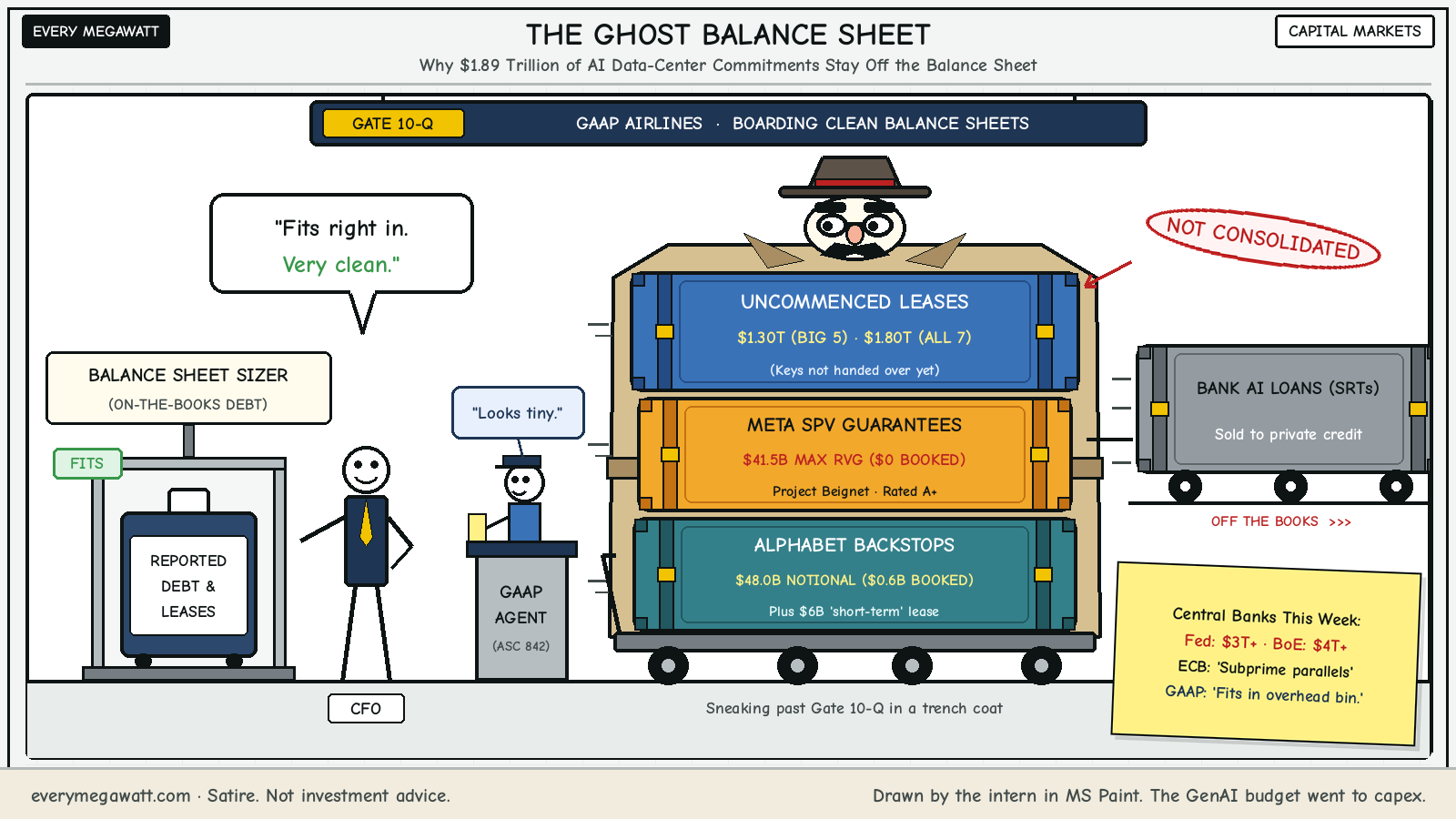
Across the Big 5 hyperscalers alone, leases signed but not yet started now total $1.30 trillion across their latest SEC filings: $364.6 billion at Microsoft (starting FY27 to FY34), $355.7 billion at Meta (terms up to 30 years), $288.0 billion at Oracle (15-to-19-year data-center leases), $164.9 billion at Amazon, and $130.5 billion at Alphabet (terms up to 26 years).
Add Anthropic ($451.2 billion in its November 19 IPO prospectus, up ninefold from $50.2 billion nine months earlier) and CoreWeave ($47.4 billion in its Q3 2026 10-Q), and just seven public companies have signed $1.80 trillion in leases that have not touched a balance sheet yet.
Trick 2: Cosign the Building, Call Someone Else the Landlord
Meta turned off-balance-sheet construction into a signature move.
In October 2025, Meta partnered with Blue Owl Capital funds to build its Hyperion data-center campus in Louisiana (~$27 billion estimated cost), taking 20 percent equity while Blue Owl took 80 percent. In July 2026, Meta ran the exact same play for a $14 billion Texas campus venture.
To fund Louisiana, a special-purpose vehicle called Beignet Investor LLC sold $27.3 billion of senior secured bonds due May 2049 at a 6.581 percent coupon (BondTerminal). S&P gave those bonds an A+ rating.
Lenders did not hand $27.3 billion to a brand-new LLC because rural Louisiana server shells have great resale value. They lent because Meta stands underneath it.
Here is how Meta kept the debt off its books. It signed only an initial four-year lease on each campus (starting 2028 in Texas and 2029 in Louisiana, renewable up to 20 years), paired with Residual Value Guarantees (RVGs): if Meta walks away after four years and the campus is worth less than an agreed floor, Meta pays the shortfall.
Think of it like having a friend take out an $80,000 loan to buy a truck and rent it to you for four years. You tell your own bank the loan is not yours because you are only renting. The catch is a side promise: if you hand the truck back after four years and it only sells for $40,000, you have to write a $40,000 check to cover the loss. The debt sits on your friend's credit report, even though you take the hit if the truck loses value.
Why does that venture stay off Meta's balance sheet? Straight from Meta's Q3 2026 10-Q:
"On the basis of analyses performed for the Ventures, decisions pertaining to remarketing the data center campus, including but not limited to, negotiations with future lease tenants and individual property sales, were determined to have the most significant impact on each Venture's economic performance. As we do not have the power to direct the activities that most significantly impact each Venture's economic performance, we are not the primary beneficiary for either Venture and, therefore, do not consolidate the variable interest entities (VIEs)."
In plain English: Meta designs the campus, manages construction, manages the property, occupies the campus, and backstops the bonds. It stays off Meta's books because if Meta leaves, someone else picks the next tenant. Meta's own auditor flagged that call as a Critical Audit Matter in the FY2025 10-K.
Meta's disclosed maximum exposure to loss in those two ventures jumped from $46.0 billion at year-end 2025 to $68.4 billion by September 30, 2026, including $41.5 billion in maximum residual-value guarantees. Liability booked on Meta's balance sheet for that $41.5 billion guarantee: zero. Per Meta: "RVG payments are not probable, and therefore no liability has been recorded to date."
Trick 3: Cosign a Partner's Rent as a "Credit Derivative"
Alphabet added two creative footnotes of its own in its Q3 2026 10-Q.
First, Alphabet backstops third-party data-center rent and energy bills for up to 15 years so partners can finance builds, booking them as credit derivatives. In nine months, the notional amount (Alphabet's maximum payout on default) nearly tripled from $16.9 billion to $48.0 billion. The liability sitting on Alphabet's balance sheet for that $48.0 billion backstop? Just $606 million, about 1.3 cents on the dollar, because GAAP only books today's estimated fair value of the risk, not the face value of the check.
Second, Alphabet disclosed a $6.0 billion non-cancelable lease signed in June 2026 and amended in September that never touches the balance sheet because its term is 12 months or less. Most companies use the short-term lease exemption for copiers. Alphabet used it for $6 billion of compute infrastructure.
Trick 4: The Banks Play Pass-the-Parcel Too
According to the Federal Reserve's November Financial Stability Report (Box 2.2, Leverage in the Data Center Buildout, as cited by Fortune), major U.S. banks already hold close to $1 trillion in exposure across tech firms, data-center developers, AI SPVs, private credit, and utilities. Now banks are copying their clients: Semafor reported this week that Citigroup and JPMorgan Chase are marketing portfolios of AI loans to outside investors via synthetic risk transfers (SRTs). The bank keeps the loan on its desk to preserve the client relationship while paying outside investors to take the first hit if the borrower trips.
The hyperscaler moves the building to an SPV. The bank moves the loan risk to private credit. Everybody wants the megawatts; nobody wants the mortgage on their own balance sheet.
The Scorecard: The Shadow Leverage Multiplier
To separate real exposure from social-media panic, the Capital Markets Desk is introducing the Shadow Leverage Multiplier (SLM):
1.00x means every obligation sits on the balance sheet. 4.00x means the footnotes are three times larger than everything on the books. We deliberately exclude general purchase orders (chips, electricity, software) so the scorecard measures only leases and credit guarantees.
Sources: Direct SEC EDGAR filings as of Sept 30, 2026 (Oracle as of Aug 31, 2026; Anthropic pro forma post-IPO per Nov 19 Form 424B4). Meta's Q3 10-Q does not separate finance leases ($1.2B at FY25 year-end) and excludes $18.5B of JV lease commitments from the backstop column to avoid double-counting with its $355.7B uncommenced total. Alphabet's backstop column excludes its $6.0B <=12-month lease. Apples-to-apples note: recognized balance-sheet leases are present value, while uncommenced leases are undiscounted future payments over 1 to 30 years, which overstates their debt-equivalent present value by roughly 25% to 35%.
What Is Hype vs. What Actually Bites
If you scroll doomer threads on X, you will see people add every power bill, chip order, and 25-year rent check together and yell that Big Tech is hiding $4 trillion of secret debt. That is sloppy math, and it misses the real risk.
Three honest caveats keep this from being 2008 tomorrow morning:
1.Future rent is not the same as a matured bond. Discounting a 20-year undiscounted lease back to today's dollars cuts its debt equivalent by roughly a quarter to a third.
2.These leases buy earning assets. Unlike a subprime mortgage on an empty house, an AI data-center lease comes with power and servers producing cloud revenue.
3.Some contracts have escape hatches. Inside Anthropic's $900.9 billion total committed spend, $186.2 billion carries termination rights or contingent conditions if a partner cannot secure financing or permits, and Anthropic exited its IPO with $232.4 billion in pro-forma cash and short-term investments. Microsoft likewise notes that some of its $364.6 billion uncommenced leases are conditional.
Now look at the two things that actually bite, which explain why four central banks and regulators all picked up the same footnotes at once.
First is who has the cash cushion. Look at the last column of the table (Off-BS / OCF). Amazon (1.0 year of operating cash flow), Alphabet (1.0 year), and Microsoft (1.9 years) print enough cash to absorb huge footnotes even if cloud margins wobble. Oracle carries $288.0 billion in 15-to-19-year data-center leases on top of $169.1 billion in balance-sheet debt and leases against $46.9 billion of trailing operating cash flow (6.1 years in uncommenced leases alone). Meta runs a 4.46x Shadow Leverage Multiplier alongside $454.5 billion in additional non-cancelable contractual commitments, just as quarterly free cash flow slipped negative (-$2.1 billion in Q3). And CoreWeave, whose five-year default insurance hit record highs in our Thanksgiving credit dispatch, holds $113.6 billion of combined on- and off-balance-sheet debt and leases against $7.2 billion of trailing operating cash flow (15.8 years).
Second is the calendar mismatch between buildings and chips. Big Tech is signing 15-to-30-year real-estate and power bills to run GPUs whose economic life, as we showed in The Eviction Ratio, runs on three-to-five-year silicon cycles. Every off-balance-sheet promise shares the same catch: Meta's $41.5 billion guarantees, Alphabet's $48.0 billion backstops, and Wall Street's synthetic risk transfers stay quietly marked "not probable" right up until the exact quarter AI demand slows down.
That is the punchline of the Ghost Balance Sheet. Under GAAP, a $41.5 billion guarantee costs zero dollars on the books as long as everything goes right. Every megawatt will be monetized, and if it is not, the footnotes will finally introduce themselves to the balance sheet.
Unlock the full research note, SEC filing tables, and exhibits immediately. You’ll also receive Was Every Megawatt Monetized? every Saturday: the Neocloud Guppy Index standings, 27-company AI infrastructure scorecards, and what the desk is watching next week. Free, one-click opt-in.
Already subscribed? Enter your email above to unlock on this device. No duplicate emails.
Every Megawatt, "The Ghost Balance Sheet: How Big Tech Parked $1.89 Trillion of AI Commitments in the Footnotes" (2026-11-27). https://everymegawatt.com/the-ghost-balance-sheet
Every Saturday: the Neocloud Guppy Index standings, SEC filing and debt scorecards across 27 AI infrastructure names, MS Paint exhibits, and what the desk is watching next week. Free, one-click opt-in.