HP Sold 29 Percent Fewer PCs, Collected 14 Percent More Revenue, and Still Sent Memory 40 Percent of the Bill
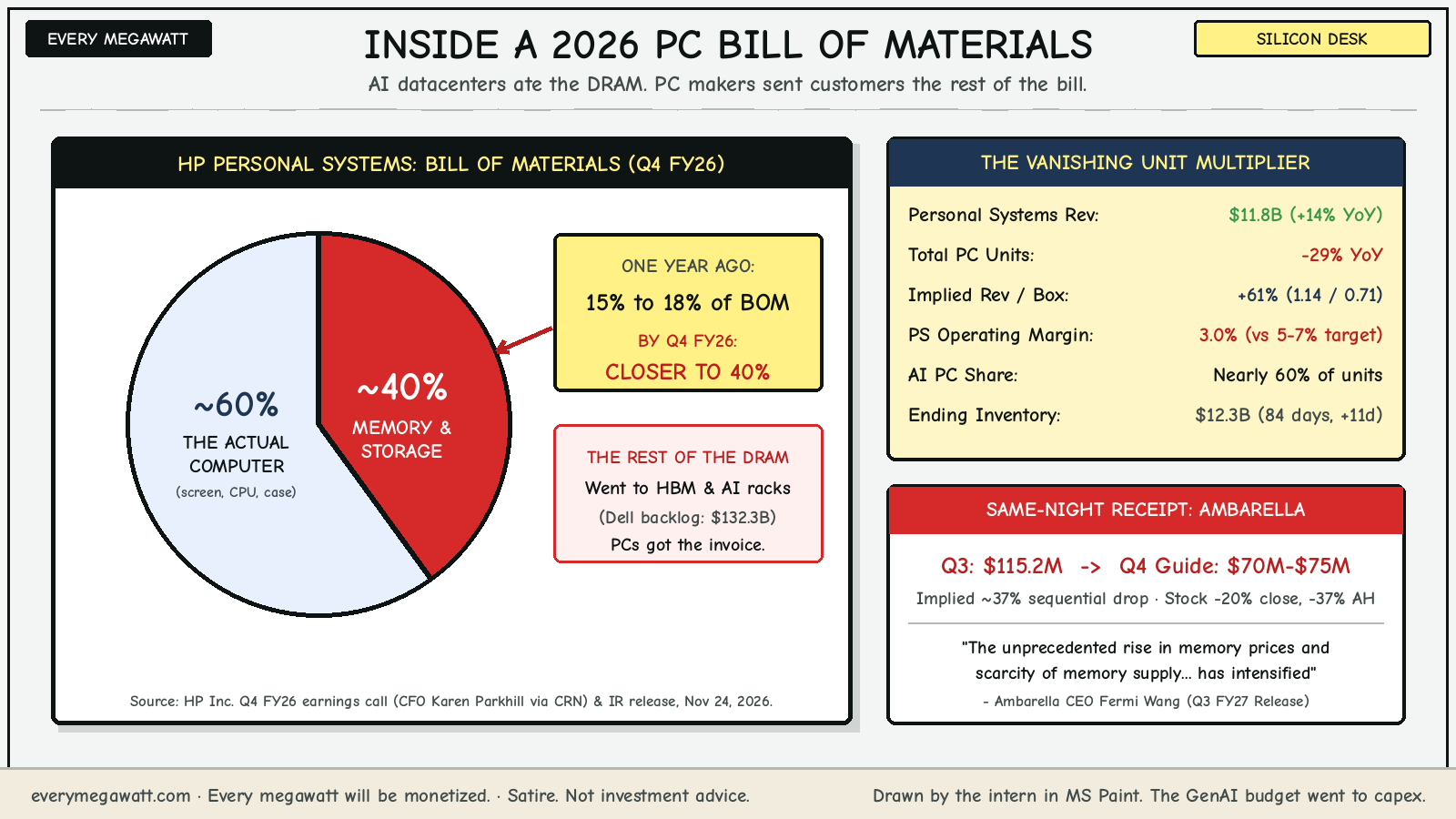
CFO Karen Parkhill said memory and storage went from 15 to 18 percent of HP's PC bill of materials at the start of the year to nearly 40 percent by Q4. Personal Systems revenue hit $11.8 billion. The units left town.
Earlier today we covered Dell's $54.9 billion quarter and $132.3 billion AI server backlog, where COO Jeff Clarke warned that DRAM wafer capacity diverted to HBM means the memory crunch runs clearly into 2027. After Tuesday's close, HP Inc. (`HPQ`) showed up with the other side of that invoice.
In its fiscal fourth-quarter release, HP posted net revenue of $16.0 billion (up 9.3 percent year over year), GAAP diluted EPS of $0.84 (inside its $0.74 to $0.84 outlook), and non-GAAP diluted EPS of $0.83 (above its $0.69 to $0.79 outlook; both figures included a $0.15 favorable impact from tariff refunds versus $0.08 in prior outlook). The board raised the quarterly dividend to $0.31 and guided FY27 non-GAAP EPS to $3.15 to $3.45 with $2.9 billion to $3.1 billion in free cash flow.
Then everyone opened the Personal Systems line. Revenue jumped 14 percent to $11.8 billion (Commercial up 23 percent, Consumer down 7 percent), while total PC units plunged 29 percent (Consumer units down 31 percent, Commercial down 28 percent). Segment operating margin compressed to 3.0 percent, while Printing quietly printed a 19.7 percent operating margin on $4.3 billion in sales and inventory swelled to $12.3 billion (84 days, up 11 days sequentially).
When Memory Eats 40 Percent of the Laptop
On the earnings call, CFO Karen Parkhill explained where the rest of the laptop went. As reported by CRN, Parkhill said: "At the beginning of last year we did say that memory and storage costs represented 15 to 18 percent of the bill of materials at the beginning of the year, and we expected that to double in the year. That did hold true for last year, and by [HP's fiscal] Q4, our memory and storage was closer to 40 percent of the bill of materials." She added that memory and storage costs are still expected to rise in fiscal 2027, though at a slower rate, with CPU costs climbing too.
| Segment / Metric | Q4 FY26 Actual | Context |
|---|---|---|
| Total Net Revenue | $16.0B (+9.3% YoY) | FY26 total $60.5B (+9.5%) |
| Personal Systems Revenue | $11.8B (+14% YoY) | Operating margin compressed to 3.0% (long-term range 5% to 7%) |
| Personal Systems Units | -29% YoY | Consumer -31%, Commercial -28% |
| Memory & Storage Share of BOM | ~40% | Up from 15% to 18% at start of year (Parkhill via CRN) |
| AI PC Shipment Mix | Nearly 60% of shipments | Ahead of 50% target (Interim CEO Bruce Broussard) |
| Ending Inventory | $12.3B (84 days) | Up 11 days quarter over quarter |
We are logging a new Silicon Desk ratio: The Vanishing Unit Multiplier. Growing Personal Systems revenue 14 percent while shipping 29 percent fewer units implies roughly 61 percent more revenue per PC (`1.14 / 0.71 = 1.61`). Interim CEO Bruce Broussard noted that AI PCs reached "nearly 60% of shipments," while Parkhill projected on the call (per Investing.com's transcript) that calendar 2027 industry PC unit volume will decline high single to low double digits even as higher prices keep total revenue roughly flat. The AI PC is winning share of a shrinking box, and nearly half of that box is now memory.
HP's stock acted accordingly. After closing regular trading down 3.32 percent at $27.94 (Investing.com / Seeking Alpha), shares surged more than 14 percent after hours, reversed to down 3.4 percent around 4:38 PM ET (Investing.com), and later traded near $28.50 (up roughly 2 percent, within an after-hours range of $26.58 to $32.79 per Seeking Alpha and Public.com).
Same-Night Confirmation at the Edge
If anyone wondered whether the DRAM squeeze was just an HP problem, edge-AI chipmaker Ambarella answered the question the exact same evening. In its Q3 FY27 release, Ambarella reported $115.2 million in revenue (+6.2 percent YoY) and $0.28 in non-GAAP EPS, then guided Q4 revenue down roughly 37 percent sequentially to $70.0 million to $75.0 million.
CEO Fermi Wang did not mince words in the release: "The unprecedented rise in memory prices and the scarcity of memory supply we previously highlighted has intensified and is causing many customers to reduce their outlooks." After closing down 19.96 percent at $44.47, Ambarella shares plunged another 37 to 38 percent in extended trading to roughly $27.21 to $28.00 (MarketWatch; Investing.com).
Every megawatt will be monetized. The catch is that once the datacenter takes the HBM wafers, whoever still builds ordinary computers has to charge 61 percent more per box just to keep the RAM inside it.
Satire. Not investment advice.
Sources
- HP Inc. Q4 & FY26 Official Results Release (Nov 24, 2026)
- CRN: HP AI PC, Memory BOM & Q4 Call Takeaways (Nov 24, 2026)
- Investing.com: HP After-Hours Surge & Reversal (4:38 PM ET)
- Investing.com: HP Q4 FY26 Call Transcript
- Ambarella Q3 FY27 Official Results Release (Nov 24, 2026)
- MarketWatch: Ambarella Q4 Outlook & Extended Drop
- Investing.com: Ambarella Q3 FY27 Call Transcript
- Every Megawatt: Dell Q3 FY27 It's Over / We're So Back (Nov 24, 2026)


